Stop Waiting for Your Life to Change
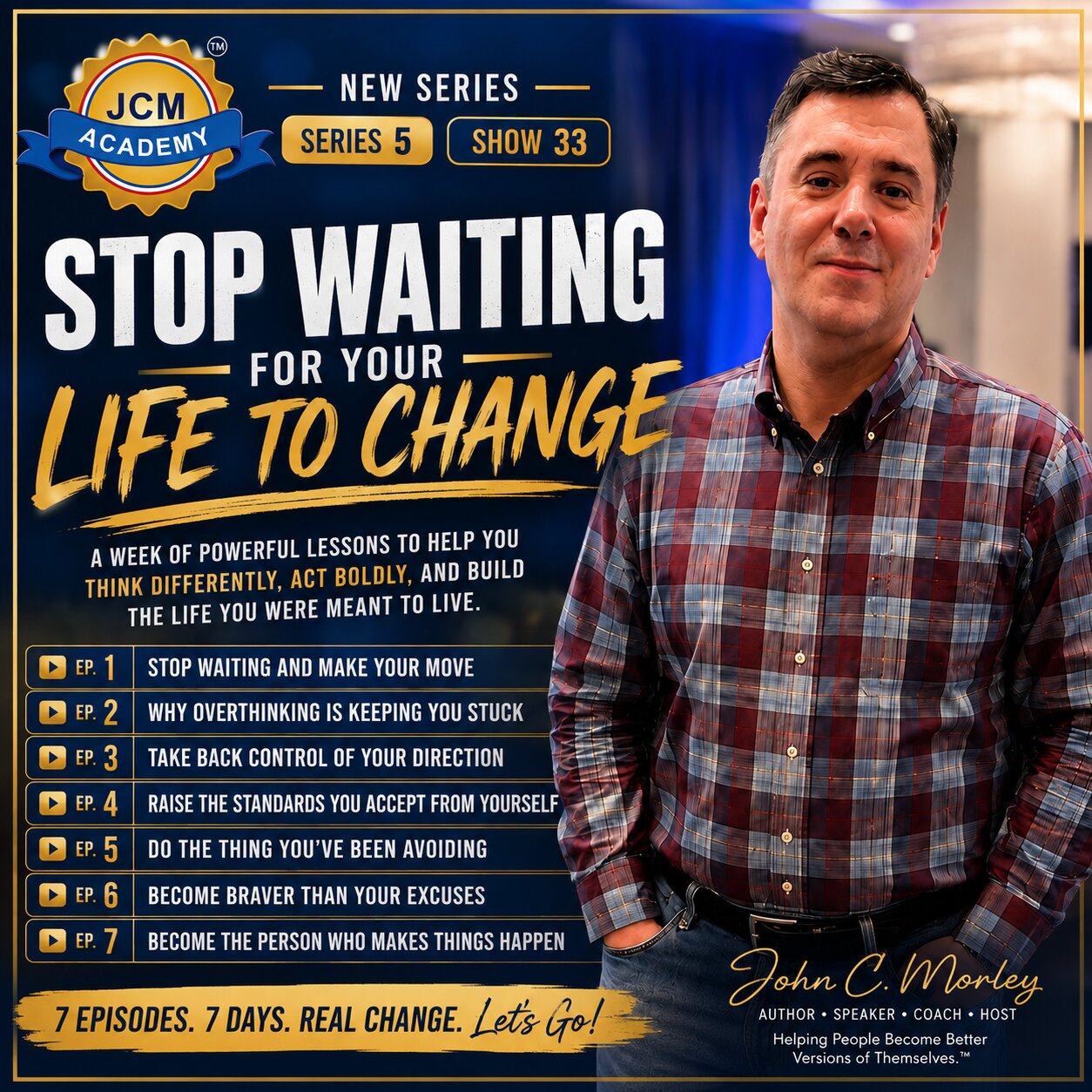
Stop Waiting and Make Your Move (S5) S33:E1 Saturday
https://www.youtube.com/watch?v=__fR6y99GWY&t=1s
Why Overthinking Is Keeping You Stuck (S5) S33:E2 Sunday
https://www.youtube.com/watch?v=Hk8DJDg4E1w&t=1s
Take Back Control of Your Direction (S5) S33:E3 Monday
https://www.youtube.com/watch?v=Tlg5iXrlBh4&t=3s
Raise the Standards You Accept From Yourself (S5) S33:E4 Tuesday
https://www.youtube.com/watch?v=2mEHsxfuHfM&t=1s
Do the Thing You've Been Avoiding (S5) S33:E5 Wednesday
https://www.youtube.com/watch?v=Dzlx6FSfhx0
Become Braver Than Your Excuses (S5) S33:E6 Thursday
https://www.youtube.com/watch?v=xuKjG4LEX4Q
Become the Person Who Makes Things Happen (S5) S33:E7
https://www.youtube.com/watch?v=AeEc8yG4qxQ
Stop Waiting for Your Life to Change
A peculiar kind of frustration comes from knowing you are capable of more while watching another week, month, or year pass without making the change you keep telling yourself you want. From the outside, life may appear perfectly functional. Responsibilities are handled, work gets completed, commitments are honored, and there may even be accomplishments others admire. Internally, however, something feels unfinished. You know there is a conversation you need to have, a decision you need to make, an idea you need to pursue, a habit you need to change, or a direction you need to reconsider, yet somehow the moment for action continually gets pushed into the future.
This is one reason the question of why I feel stuck in life can be so difficult to answer. Feeling stuck does not necessarily mean that nothing is happening. Some of the busiest and most accomplished people can feel profoundly stuck because activity and movement are not the same thing. A person can spend every day responding to emails, attending meetings, solving problems, meeting deadlines, helping other people, and managing responsibilities without making meaningful progress toward something that matters deeply to them. Life remains full, but its direction begins to feel increasingly disconnected from intention.
High achievers can be particularly vulnerable to this experience because competence creates its own momentum. When you are good at solving problems and carrying responsibility, people naturally give you more problems to solve and more responsibility to carry. Success can gradually fill a calendar so completely that there is little room left to ask whether the life being maintained is still the life you consciously want to build. This helps explain why someone can become successful but emotionally exhausted or wonder why high achievers feel stuck despite possessing the skills, resources, and determination that should seemingly allow them to change direction whenever they choose.
The uncomfortable truth is that knowing something needs to change and actually changing it are entirely different processes. Awareness is necessary, but awareness alone does not alter circumstances. We can understand exactly why a habit is hurting us and continue practicing it. We can recognize that a professional situation no longer serves us and remain there indefinitely. We can know that an important conversation needs to happen and spend months avoiding it. We can possess an idea with enormous potential and continue refining it privately until someone else eventually acts on a similar opportunity. Insight can illuminate the path, but at some point we still have to walk it.
That distinction is at the center of this week's Stop Waiting for Your Life to Change (S5) S33. Across seven episodes, we move beyond simply recognizing that something feels wrong and examine what happens when we begin taking responsibility for changing direction. We will explore why waiting can become a habit, how overthinking disguises itself as preparation, what it means to regain control of our direction, why personal standards influence the lives we build, how avoidance quietly increases the difficulty of problems, why excuses can become more powerful than fear itself, and what separates people who continually discuss possibilities from those who consistently turn ideas into results.
The objective is not to promote reckless action or suggest that every difficult circumstance can be changed through determination alone. Some situations require patience. Some decisions deserve considerable thought. Some circumstances involve limitations that cannot be overcome through positive thinking alone. Thoughtful action begins by understanding reality as accurately as possible. The danger arises when patience becomes indefinite postponement, preparation becomes avoidance, and circumstances become a permanent explanation for why we never attempt what remains within our control.
A different future rarely begins with everything around us suddenly becoming easier. More often, it begins when we decide that waiting for ideal conditions is no longer an acceptable strategy.
Stop Waiting and Make Your Move
There is almost always a reason to wait. We can wait until we have more money, more confidence, more experience, more information, more time, a larger network, fewer responsibilities, a better economy, a more supportive environment, or some unmistakable signal that tells us the moment has finally arrived. Each explanation can sound completely reasonable on its own, which is precisely why waiting can become so difficult to recognize as a pattern. We rarely announce that we intend to postpone something important indefinitely. We postpone it until circumstances improve, and then discover another condition that still needs to be satisfied.
Stop Waiting and Make Your Move (S5) S33:E1 examines the distance between wanting change and initiating it. Most meaningful transitions begin before certainty exists because certainty is often something we gain through action rather than something we possess beforehand. The entrepreneur cannot know exactly how the market will respond before launching. The writer cannot know how readers will receive a book before finishing it. The professional considering a new direction cannot experience that future career while remaining entirely inside the old one. The person attempting to rebuild a relationship cannot guarantee the outcome before beginning an honest conversation. At some point, information reaches its practical limit and experience must provide the next lesson.
This does not mean preparation is unnecessary. Good preparation increases the quality of action and reduces avoidable mistakes. Research matters, planning matters, financial analysis matters, education matters, and understanding consequences matters. The problem begins when preparation no longer has a defined relationship with execution. Someone can spend months researching a project that could have produced useful feedback after a few weeks of testing. Another person can continually take courses without applying what has already been learned. A business idea can remain trapped in documents, spreadsheets, and conversations because developing the plan feels safer than letting customers evaluate the actual concept.
Waiting also has a psychological advantage that we rarely acknowledge: an untested possibility can remain perfect. The business that has never launched cannot fail. The book that has never been submitted cannot be rejected. The conversation that has never happened cannot produce an uncomfortable response. The application that has never been sent cannot be declined. As long as possibility remains theoretical, we can preserve the belief that success might have occurred under the right circumstances. Action introduces reality, and reality can challenge the stories we tell ourselves about what might happen.
Yet reality also provides something imagination cannot: progress. Once we act, we gain information. We discover what works, what needs improvement, what assumptions were incorrect, what resources are missing, and what opportunities we could not see from the starting point. Even an imperfect result can move us forward because it replaces speculation with evidence. The person willing to make a thoughtful move gains access to information that remains unavailable to the person still standing at the beginning trying to predict every possible outcome.
Waiting also carries a cost that becomes visible only with time. Opportunities have windows. Relationships change. Industries evolve. Technology advances. Energy fluctuates. Priorities shift. The circumstances we assume will remain available indefinitely may look completely different several years from now. This does not mean we should live with constant urgency, but it does mean time deserves to be treated as a real factor in decision-making rather than an unlimited resource.
For someone who feels stuck despite success, making a move does not necessarily require abandoning everything already built. Change can begin much more intelligently. It might involve starting a project alongside existing responsibilities, setting a boundary that creates room for something important, learning a skill needed for the next stage, contacting someone who can provide perspective, testing an idea on a small scale, or finally putting a date on something that has existed only as an intention. The first move does not need to contain the entire journey. Its purpose is to change the condition from waiting to moving.
Confidence frequently follows the same pattern. We tend to imagine that confident people act because they already possess confidence, but confidence often comes from evidence accumulated through action. We become more confident speaking by speaking. We become more confident leading by accepting leadership responsibilities. We become more confident solving difficult problems by solving increasingly difficult problems. Waiting until we feel completely confident can create a paradox: the experience required to develop confidence never occurs.
The challenge is to recognize when caution protects us and when it merely protects our comfort. Genuine caution asks useful questions about risk, resources, timing, and consequences. Fear disguised as caution repeatedly produces new reasons to act later. Learning to distinguish between the two requires honesty because nobody else can completely evaluate the private explanations we use to postpone our own decisions.
Making your move is ultimately an act of participation in your own future. It acknowledges that circumstances matter, timing matters, and uncertainty is real, while refusing to surrender every decision to those forces. You may not control the entire path, but there is almost always some meaningful action available within the portion you do control. Finding that action and taking it changes more than the immediate situation. It begins rebuilding the relationship between intention and behavior.
Why Overthinking Is Keeping You Stuck
Thoughtfulness is an advantage until thinking becomes a substitute for deciding. The ability to anticipate consequences, consider alternatives, recognize risk, and examine a problem from several perspectives can prevent enormous mistakes. Yet those same abilities can become obstacles when every answer produces another question and every possible direction creates another scenario requiring analysis. What initially looks like responsible consideration can gradually become a sophisticated form of avoidance.
Why Overthinking Is Keeping You Stuck (S5) S33:E2 explores what happens when the desire to make the perfect decision prevents us from making a useful one. Overthinking often feels productive because the mind remains extremely active. We replay conversations, imagine outcomes, compare possibilities, research alternatives, reconsider assumptions, and attempt to eliminate uncertainty before acting. From the inside, this can feel like serious preparation. The problem is that some uncertainty cannot be removed through additional thought because the missing information exists only on the other side of experience.
This is particularly challenging for intelligent, analytical, and highly responsible people. The more consequences someone can imagine, the easier it becomes to generate reasons for hesitation. A capable mind can construct convincing arguments for almost any position, including why today is not the right day to begin. We can convince ourselves that one more piece of information will provide clarity, even when the real issue is that no amount of information can guarantee the outcome we want.
Perfectionism frequently enters the process because the imagined perfect decision carries no regret. If we could somehow identify the ideal choice, execute it flawlessly, and know the result in advance, uncertainty would disappear. Real decisions rarely offer that luxury. They are made with incomplete information by imperfect people operating inside changing circumstances. Good judgment therefore does not mean eliminating uncertainty. It means becoming capable of making responsible decisions despite uncertainty.
Overthinking can also magnify risk while minimizing the cost of inaction. When considering a new opportunity, we may imagine everything that could go wrong if we pursue it without spending equal time considering what might happen if we never try. Remaining where we are feels neutral because it requires no visible decision, yet maintaining the status quo is itself a choice. Five years spent avoiding change still produces a five-year outcome.
Breaking this pattern requires establishing a point at which thinking must become action. That might involve identifying the information genuinely required to make a responsible decision, setting a reasonable deadline, seeking perspective from someone qualified to challenge our assumptions, and accepting that some questions will remain unanswered. The objective is not impulsiveness. It is preventing analysis from expanding indefinitely simply because uncertainty feels uncomfortable.
For people wondering why they feel stuck in life, this can be an important area to examine. Sometimes we lack ideas, opportunities, or ability. We are trapped inside a decision that has remained open for so long that thinking about it has become more familiar than resolving it. Closing that loop can release enormous mental energy because unresolved decisions occupy attention even when we are not consciously addressing them.
Action also corrects overthinking by providing feedback. Once we begin, the hypothetical problem becomes real, with observable characteristics. Instead of imagining how an audience might respond, we can listen to the actual audience. Instead of wondering whether a new routine might work, we can test it. Instead of repeatedly predicting how someone might respond to a conversation, we can communicate respectfully and find out. Reality may not provide the response we hoped for, but it gives us something more useful than endless speculation: information we can use.
The goal is not to stop thinking. It is to make thinking serve action rather than replace it. Reflection should improve decisions, preparation should strengthen execution, and analysis should eventually produce direction. When thought becomes an endless loop designed primarily to protect us from uncertainty, the intelligence that should help us move forward begins holding us in place.
Take Back Control of Your Direction
Lives rarely move dramatically off course in a single afternoon. Direction usually changes gradually through small compromises, postponed priorities, responsibilities accepted without reflection, and routines that become permanent simply because they are familiar. One day we look at a calendar filled with obligations and realize that almost everything demanding our attention originated from decisions made months or years earlier. We are moving constantly, yet much of that movement has become reactive.
Take Back Control of Your Direction (S5) S33:E3 is about recognizing the difference between controlling every circumstance and taking responsibility for the direction we influence. Nobody controls everything that happens. Economic conditions change, organizations restructure, other people make decisions that affect us, unexpected expenses appear, opportunities disappear, and life introduces circumstances we could never have anticipated. Personal responsibility does not require pretending these realities do not exist. It requires identifying the choices that remain ours despite them.
Direction begins with priorities because time eventually exposes what we have actually prioritized. We may say health matters, relationships matter, learning matters, family matters, or a long-postponed goal matters. Still, if those things continually receive whatever time remains after everything else, our behavior is communicating a different hierarchy. This does not mean every priority receives equal time. Different seasons legitimately require different levels of attention. The important question is whether the imbalance is intentional or whether temporary circumstances have quietly become a permanent lifestyle.
Regaining direction sometimes begins by deciding what we will stop doing. Growth is frequently described through addition: another habit, another goal, another responsibility, another project. Yet calendars and human capacity are finite. Every new commitment competes with something already present. If we keep adding without removing, even meaningful opportunities eventually become sources of exhaustion because we have no capacity left to pursue them well.
Boundaries become an important part of direction for precisely this reason. Saying no is not inherently negative. A thoughtful no protects the yes we have already given to something more important. Without boundaries, other people's priorities can gradually determine the architecture of our lives. This is particularly common among dependable people because competence attracts requests. The more capable we become, the more opportunities we receive to spend our time helping accomplish objectives that may have little to do with our own priorities.
Taking back control can therefore involve difficult choices. It may mean disappointing someone who expected continued access to our time. It may mean leaving a comfortable situation that no longer supports growth. It may require admitting that an old goal no longer represents the person we have become. Direction is not maintained by stubbornly following every plan we once created. Sometimes intentional living requires changing the plan because experience has given us better information.
This is also where people who are successful but emotionally exhausted may need to examine the structure surrounding their achievements. If success requires a permanent level of exhaustion that eliminates health, relationships, curiosity, and enjoyment, the issue may not be insufficient resilience. The structure itself may need reconsideration. Sustainable ambition asks not merely whether something can be accomplished, but whether the way we accomplish it supports the life we intend to build.
Taking back control does not happen through one dramatic declaration. It happens through decisions that gradually realign behavior with values. We reclaim an hour. We decline an obligation. We establish a boundary. We return to something important that has been neglected. We change a routine that no longer works. We decide that our calendar should reflect more than the demands arriving most loudly.
Direction is ultimately less about predicting exactly where we will be years from now and more about making sure today's movement is intentional enough to take us somewhere worth reaching.
Raise the Standards You Accept From Yourself
Standards operate quietly because they determine what we consider acceptable long before anyone else sees the final result. They influence how carefully we prepare, whether we keep commitments, how we respond when motivation disappears, what behavior we tolerate from ourselves, and whether we correct something we know could have been done better. Goals describe what we hope to achieve, while standards influence how we behave repeatedly enough to make those achievements possible.
Raise the Standards You Accept From Yourself (S5) S33:E4 is not an invitation to perfectionism or relentless self-criticism. Healthy standards should not require us to become incapable of forgiving mistakes or accepting ordinary human limitations. The objective is to develop expectations that support growth, not excuses that continually lower the quality of what we are willing to accept from ourselves.
There is an important difference between making a mistake and normalizing one. Everyone misses something occasionally. Everyone experiences days when energy is lower, judgment is imperfect, or circumstances interfere with the plan. The danger begins when exceptions become explanations and explanations become identity. "I was late today" is an event. "I'm just always late" transforms behavior into a permanent characteristic and quietly removes the expectation that it should change.
Standards influence confidence because keeping commitments to ourselves creates evidence of reliability. When we repeatedly say we will do something and then fail to follow through, we gradually teach ourselves that our intentions cannot be trusted. Conversely, when we establish realistic expectations and honor them consistently, confidence grows from experience rather than affirmation. We know we can depend on ourselves because we have accumulated evidence to show it.
Professional standards operate similarly. The person who checks their work when nobody requires it, prepares thoroughly before an important meeting, communicates when something goes wrong, and takes responsibility rather than immediately searching for someone else to blame is developing a reputation before anyone formally describes it. Character becomes visible through repeated behavior.
Raising standards does not necessarily mean doing more. Sometimes a higher standard requires doing fewer things better. Constant overcommitment can produce mediocre execution across responsibilities that individually deserve greater attention. The higher standard may be recognizing capacity honestly, declining what cannot be done properly, and giving appropriate attention to what remains.
Standards also shape the environments we create. When leaders consistently accept poor communication, missed commitments, disrespectful behavior, or unfinished work, those behaviors gradually become cultural norms. When expectations are clear, reasonable, and consistently modeled, people understand what quality looks like. The same principle applies personally. What we repeatedly tolerate eventually starts to feel normal.
A meaningful standard should challenge us without destroying us. It should encourage preparation without demanding perfection, consistency without eliminating flexibility, and responsibility without turning every mistake into evidence of personal failure. Raising the standards we accept from ourselves means refusing to use comfort as the primary measurement of what we are capable of becoming.
Do the Thing You've Been Avoiding
Avoidance is expensive because unresolved problems rarely remain the same size while we ignore them. A difficult conversation becomes more awkward as time passes. An administrative problem acquires another deadline. A health concern creates additional uncertainty. An unfinished project occupies mental space every time we remember it. The task itself may require only a modest amount of time, yet the emotional energy spent repeatedly postponing it can far exceed the effort required to address it.
Do the Thing You've Been Avoiding (S5) S33:E5 examines why certain responsibilities gain power precisely because we refuse to confront them. Avoidance provides immediate relief, which makes it psychologically attractive. We postpone the uncomfortable task and feel better for a while. Unfortunately, the relief rewards the avoidance rather than resolving the underlying issue, making it easier to repeat the same response the next time discomfort appears.
Procrastination is therefore not always a problem of laziness or time management. Sometimes it is emotional management. We avoid tasks associated with uncertainty, embarrassment, conflict, boredom, complexity, or the possibility of failure. Understanding the emotion attached to the task can be more useful than simply telling ourselves to work harder.
The solution often begins by reducing the size of the confrontation. Instead of imagining the entire project, identify the first concrete action. Open the document. Make the call. Schedule the appointment. Write the first paragraph. Gather the information. Ask the question. Once movement begins, the task frequently becomes less intimidating because uncertainty is replaced by activity.
Avoidance can become particularly costly when it involves conversations. People sometimes spend weeks building assumptions about what another person thinks rather than asking. Resentment grows around information that has never been verified. Professional problems become larger because nobody wanted to address them early. Respectful communication may be uncomfortable, but unresolved ambiguity can become considerably more damaging.
There is also enormous psychological value in completing something that has occupied attention for too long. The relief is different from the temporary relief created by postponement because completion actually removes the obligation. That reclaimed attention becomes available for more meaningful work.
What we avoid is not always unpleasant. People also avoid opportunities that matter deeply because they expose us to judgment. Starting the business, sharing the idea, submitting the manuscript, applying for the position, or stepping into leadership can feel frightening precisely because success matters. Avoidance protects us from immediate vulnerability while simultaneously protecting us from the possibility of growth.
Doing the thing we have been avoiding is therefore about more than clearing a task list. It is practice in becoming someone who can move toward discomfort when something worthwhile exists on the other side.
Become Braver Than Your Excuses
Excuses become powerful when they contain enough truth to sound unquestionable. We really are busy. Resources really can be limited. Timing really can be imperfect. Other people really can create obstacles. Previous failures really can affect confidence. The challenge is determining whether these circumstances define what is impossible or describe what makes progress more difficult.
Become Braver Than Your Excuses (S5) S33:E6 asks us to examine the explanations we repeatedly give ourselves for remaining where we are. This is not about dismissing legitimate limitations or pretending everyone begins with equal resources and opportunities. It is about identifying the point at which an explanation stops providing useful context and begins functioning as permission to avoid every action still available to us.
Fear frequently sits underneath the most persistent excuses. We may say we do not have enough time when the deeper concern is that our effort might fail. We may insist that we need additional preparation when we are actually afraid of being evaluated. We may blame timing because acknowledging that we are frightened feels less comfortable. Excuses allow us to preserve our self-image because if circumstances prevented the attempt, our abilities were never truly tested.
Courage does not require the disappearance of fear. If fear had to vanish before courageous action became possible, courage itself would be unnecessary. Bravery means recognizing the discomfort and deciding that something else matters more. The conversation matters more than avoiding awkwardness. The opportunity matters more than protecting ourselves from rejection. Growth matters more than remaining permanently comfortable.
This perspective also changes how we respond to setbacks. A failed attempt does not prove that the excuse was correct. It provides information for the next attempt. Perhaps the strategy needs adjustment, the skill needs development, or the timing genuinely was wrong. Courage includes the willingness to examine that information without converting one disappointing result into a permanent conclusion about what is possible.
Excuses become weaker when we replace vague intentions with specific commitments. "I want to start someday" leaves unlimited room for postponement. A defined action with a date forces the idea into reality. Specificity creates accountability because we can no longer pretend that thinking about something is the same as doing it.
Becoming braver than our excuses is not a one-time transformation. New circumstances will always arise that offer reasonable explanations for hesitation. Courage becomes a practice through which we continually distinguish between what genuinely cannot be changed and what we have not yet been willing to confront.
Become the Person Who Makes Things Happen
Every organization, community, project, and relationship eventually reveals the difference between people who generate ideas and people who convert ideas into reality. Ideas matter. Vision matters. Conversation matters. Planning matters. Yet none of them creates an outcome until someone accepts responsibility for moving from discussion into execution.
Become the Person Who Makes Things Happen (S5) S33:E7 brings the week together around initiative and follow-through. The person who makes things happen does not necessarily have the loudest personality, the highest title, or the most impressive credentials. More often, they have developed a reputation for noticing what needs to be done, taking responsible initiative, communicating clearly, and staying involved long enough to see something through.
Initiative begins by reducing dependence upon being chased. In many environments, enormous energy is spent reminding people about responsibilities they already accepted. The person who follows through without repeated prompting immediately becomes valuable because reliability reduces friction for everyone around them. Trust grows when people know a commitment doesn't disappear simply because nobody sent another reminder.
Execution also requires translating conversation into specific next steps. Meetings can create the sensation of progress while producing very little if nobody leaves knowing who is responsible for what happens next. The person who makes things happen listens for that gap. What needs to happen? Who owns it? When will it be completed? What obstacle needs to be removed? These questions transform discussion into movement.
This does not mean taking over everything personally. Effective execution includes knowing when to delegate, collaborate, seek expertise, and connect people whose combined abilities can solve a problem more effectively. Making things happen is not about becoming indispensable through control. It is about creating momentum.
Follow-through becomes especially important because beginnings receive far more attention than endings. New projects are exciting. Announcements create energy. Ideas generate conversation. The middle is where complexity appears, enthusiasm fades, and unexpected problems demand adjustment. People known for execution distinguish themselves by remaining engaged after novelty disappears.
Leadership also exists here, regardless of title. Someone who consistently arrives prepared, identifies useful next steps, solves problems without unnecessary drama, communicates when circumstances change, and completes commitments is already demonstrating leadership behavior. Titles may eventually recognize that behavior, but they do not create it.
Becoming the person who makes things happen also requires judgment. Action for its own sake can create unnecessary work. Initiative should serve something worthwhile. The goal is not to become the person constantly generating activity but the person capable of recognizing where action creates genuine value.
This is where all seven lessons of the week converge. We stop waiting because movement must begin somewhere. We control overthinking so analysis eventually becomes decision. We take responsibility for our direction instead of allowing every circumstance to determine it. We raise our standards so our behavior becomes worthy of our ambitions. We confront what we have been avoiding because unresolved problems consume energy. We become braver than our excuses because fear should inform decisions without automatically controlling them. Finally, we develop the discipline of execution so ideas have an opportunity to become results.
Stop Waiting for Your Life to Change
The most important change may not be the new job, successful business, stronger relationship, healthier routine, completed project, or opportunity we eventually create. It may be the change that occurs when we stop viewing ourselves primarily as someone waiting for circumstances to improve and begin seeing ourselves as an active participant in what happens next.
There will always be parts of life beyond our control, and pretending otherwise does not create empowerment. Genuine agency comes from accurately recognizing both sides of that equation. We acknowledge the realities we cannot change while refusing to surrender the decisions that remain ours. We may not control the economy, another person's choices, every opportunity, every setback, or the timing of every outcome, but we retain considerable influence over our preparation, standards, habits, boundaries, communication, learning, effort, and willingness to act.
For someone wondering, "Why do I feel stuck in life?" the answer may not be that everything needs to change at once. Sometimes the first meaningful change is much smaller. One unresolved decision gets made. One conversation finally happens. One boundary is established. One neglected responsibility is completed. One idea moves from discussion into a real first step. These actions begin restoring something that prolonged waiting gradually erodes: the belief that our choices still matter.
This is equally important for people who are outwardly successful but emotionally exhausted. Achievement can become its own form of inertia when maintaining everything already built consumes the capacity required to reconsider direction. Continuing to accomplish more is not always the same as moving closer to a meaningful life. Sometimes progress requires asking whether the standards, commitments, habits, and expectations driving our success still deserve the authority we have given them.
Throughout Stop Waiting for Your Life to Change (S5) S33, the central message has never been that transformation is easy. Making a move can be frightening. Ending an overthinking cycle requires accepting uncertainty. Taking control of direction may require boundaries other people dislike. Raising personal standards demands consistency after motivation disappears. Confronting avoidance can be uncomfortable. Moving beyond excuses exposes us to the possibility of failure. Becoming someone who makes things happen requires responsibility for outcomes, not just enthusiasm for ideas.
That difficulty is precisely why these choices matter.
A meaningful life is not created by eliminating every uncomfortable experience. It is created partly through developing the capacity to move through discomfort when something important exists beyond it. Courage, resilience, discipline, confidence, and leadership are not abstract qualities we either possess or lack. They are strengthened through situations that require us to practice them.
The next move doesn't have to be enormous. In fact, waiting for a dramatic transformation can become another form of postponement. Choose the action that is available now. Make the call. Begin the conversation. Write the page. Submit the application. Establish the boundary. Learn the skill. Correct the mistake. Ask for help. Test the idea. Finish what you started. Take one meaningful action that creates evidence that your future is no longer merely something you are waiting to experience.
Then continue.
Because eventually those individual actions begin forming habits, those habits begin shaping identity, and that identity begins influencing the direction of an entire life.
You do not need to wait for your life to change before you begin changing how you live it.
Check out our weekly blog here.
Leave A Comment
Please login to add a comment!
Comments (0)