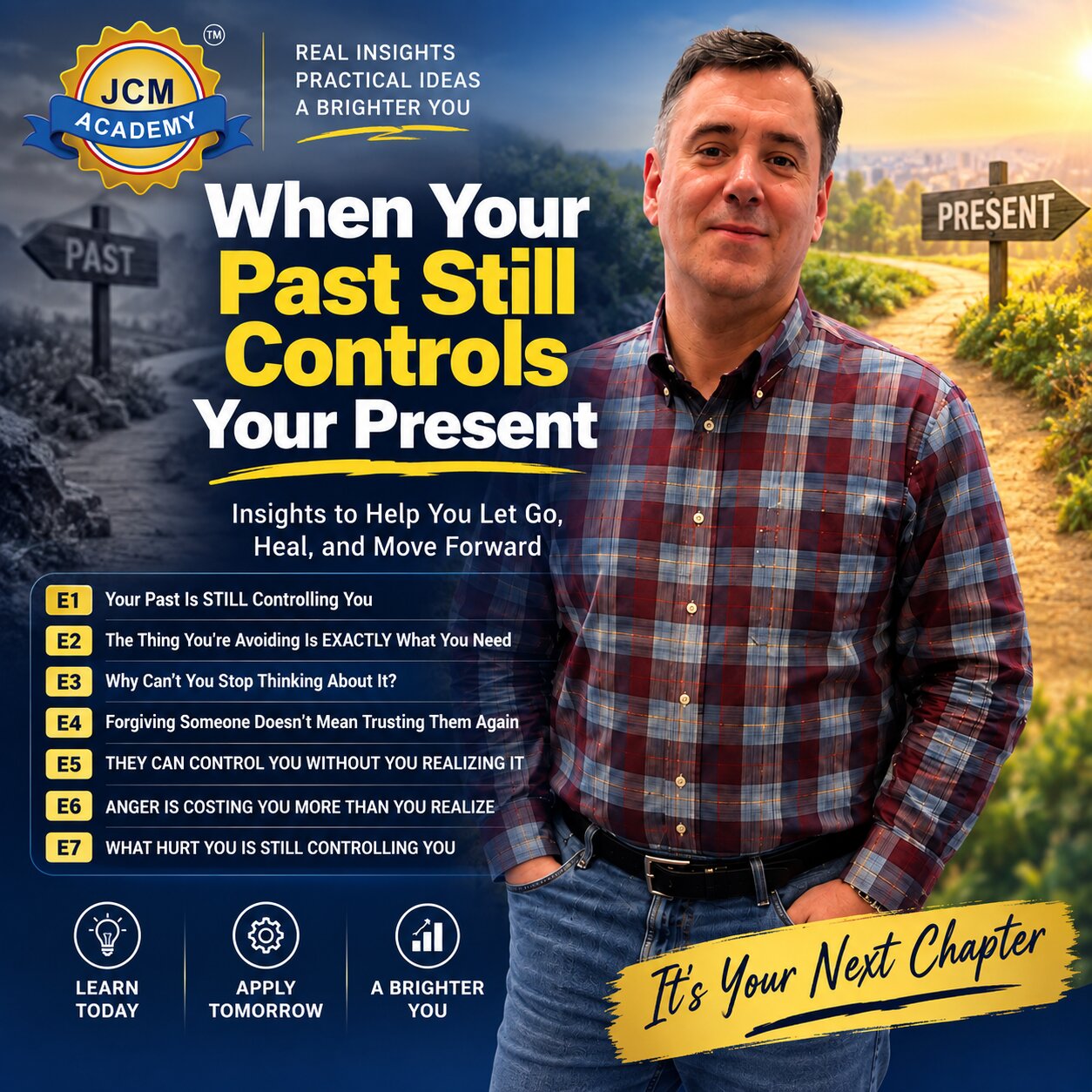
When Your Past Still Controls Your Present
Sometimes people get frustrated with themselves because they know they want something different, yet they keep reacting to life in ways tied to experiences they thought they had already left behind. They may have changed jobs, ended relationships, built new friendships, developed successful careers, created businesses, or completely transformed their circumstances. Still, changing circumstances does not automatically change the influence those circumstances had on them. The past doesn't need to remain physically present to keep shaping expectations, reactions, decisions, relationships, and how someone interprets what happens next.
This is one reason people can work incredibly hard on personal growth and still wonder why certain situations continue to affect them so strongly. They may intellectually understand that an experience is over while emotionally responding as though some part of it is still happening. A criticism from someone new can awaken the memory of criticism from years ago. A disappointing business interaction can trigger frustration that seems larger than the current situation deserves. A new relationship can be evaluated according to what happened in an old one. Instead of responding only to the person or circumstance standing in front of them, people sometimes respond to everything that person or circumstance reminds them of.
That distinction matters because moving forward is not simply about forgetting what happened. It is about understanding what influence the past still has over the present and deciding whether that influence deserves to continue. Some experiences are worth remembering because they taught valuable lessons, set necessary boundaries, or revealed something important about ourselves and others. The problem begins when remembering becomes reliving, when lessons become permanent defenses, or when something another person did years ago continues determining what we are willing to believe, attempt, trust, or become today.
This week on Inspirations for Your Life explores that relationship between the past and the present through seven connected conversations about unresolved experiences, avoidance, repetitive thinking, forgiveness, trust, control, anger, and the lingering influence of hurt. The objective is not to pretend difficult experiences never happened or to force ourselves into artificial positivity. It is to recognize when something from yesterday has gained more authority over today than it should, because genuine progress requires more than physically moving forward. It requires reclaiming the ability to decide what shapes the life we are building now.
Your Past Is STILL Controlling You (S5) S38:E1 Saturday
The past often exercises its greatest influence when we stop recognizing it as the past. An old experience can become so deeply integrated into the way we think that we no longer notice the connection between what happened then and what we do now. We describe ourselves as cautious, independent, guarded, skeptical, driven, private, or unable to tolerate certain situations, without always asking where those patterns originated or whether they still serve us.
Some of those adaptations were useful when they developed. A person who was repeatedly disappointed may have learned to rely heavily on themselves. Someone who was constantly criticized may have learned to overprepare because mistakes once carried an emotional cost. Someone whose trust was violated may have become exceptionally careful about whom they allow into their life. Those responses are understandable, and some may remain valuable. The important question is whether we are consciously choosing them today or automatically repeating them because an earlier experience trained us to expect the same outcome everywhere we go.
That is where the past can quietly become controlling. It does not necessarily announce itself through dramatic memories. Sometimes it shows up in decisions we never seriously consider, opportunities we dismiss too quickly, conversations we avoid, people we refuse to trust, or risks we automatically label as dangerous. We may believe we are making an independent decision when we are actually allowing an old experience to decide for us.
Personal growth therefore requires more than asking what happened. It requires asking what conclusions we formed because of what happened. Perhaps we concluded that asking for help makes us vulnerable, that trusting people inevitably leads to disappointment, that success requires constant exhaustion, or that protecting ourselves means never allowing anyone close enough to hurt us again. Those conclusions may have once felt necessary, but circumstances change, people change, and we change. A belief that protected us during one chapter can restrict us during another.
The objective is not to erase history. It is to prevent history from automatically becoming destiny. We can respect what an experience taught us while still questioning whether the rules we created around it belong in the life we are trying to build today.
The Thing You're Avoiding Is EXACTLY What You Need (S5) S37:E2 Sunday
Avoidance is powerful because it frequently produces immediate relief. When something feels uncomfortable, threatening, embarrassing, painful, or uncertain, stepping away from it can make us feel better almost instantly. That relief can convince us avoidance was the right decision, even when it has done nothing to resolve the underlying problem.
Over time, this creates a difficult pattern. The conversation we don't want to have becomes more intimidating because we keep postponing it. The decision we fear becomes heavier as uncertainty keeps accumulating around it. The memory we refuse to examine continues influencing us because we never understand what meaning we attached to it. Avoidance can therefore reduce discomfort today while quietly increasing its influence over tomorrow.
This does not mean every painful situation must be revisited or every person deserves another conversation. Some circumstances call for distance and boundaries. The deeper issue is whether we choose distance deliberately because it protects something important, or reflexively avoid discomfort because we do not want to confront what the situation might reveal.
Sometimes what we are avoiding is not another person at all. We may be avoiding an admission about ourselves, a pattern we have repeated, a boundary we failed to establish, or a decision we know we need to make. Confronting those realities can be uncomfortable because awareness creates responsibility. Once we recognize that something isn't working, it becomes harder to pretend nothing needs to change.
Growth often begins precisely at that point. What we have been avoiding may contain information we need to move forward. Facing it does not guarantee an easy resolution, but it can end the exhausting process of organizing our lives around something we refuse to confront.
Why Can’t You Stop Thinking About It? (S5) S38:E3 Monday
There is an important difference between remembering an experience and repeatedly living inside it. The mind naturally returns to unresolved events because it wants to understand what happened, what could have been different, and how to prevent similar pain in the future. Reflection can be valuable when it produces insight, but repetitive thinking becomes costly when it continues circling the same questions without creating new understanding.
People sometimes assume that if they think about something long enough, they will eventually discover the explanation that makes everything feel complete. Unfortunately, life does not always provide that kind of closure. Another person's behavior may never make perfect sense. We may never receive the apology we deserved, understand every motive behind a betrayal, or know exactly why an opportunity disappeared. Continuing to search for an answer that may never arrive can give the unanswered question enormous control over our attention.
This is especially difficult because repetitive thinking can masquerade as problem-solving. We tell ourselves we are trying to understand the situation, yet we may actually be replaying it. The distinction becomes clearer when we ask whether our thinking is producing anything new. Are we identifying a lesson, making a decision, changing a boundary, or developing a healthier response, or are we simply experiencing the same emotions through another round of mental review?
Attention is one of our most valuable resources, and whatever repeatedly occupies it receives part of our present life. That does not mean we should suppress difficult thoughts or become angry with ourselves whenever an old memory appears. It means we can learn to recognize when reflection has completed its useful work, and rumination has taken over.
Sometimes closure is not something another person gives us. It is the decision that we have extracted what we can from an experience and will no longer require ourselves to solve every unanswered question before continuing with our lives.
Forgiving Someone Doesn't Mean Trusting Them Again (S5) S38:E4 Tuesday
Forgiveness and trust are often treated as interchangeable, which can make forgiveness feel dangerous. If forgiving someone supposedly requires restoring the relationship to what it was before, ignoring what happened, or giving the person another opportunity to cause the same harm, then holding onto resentment can begin to feel like the only available form of protection.
But forgiveness and trust serve different purposes. Forgiveness concerns the emotional burden we continue carrying because of what happened. Trust concerns what access another person earns through their behavior. We can decide we no longer want anger, resentment, or an old betrayal consuming our attention without deciding that the person responsible should immediately regain the place they once held in our lives.
Trust is constructed through evidence. When it has been damaged, rebuilding it requires consistency, accountability, honesty, changed behavior, and time. An apology may begin that process, but an apology does not automatically complete it. Forgiveness does not require us to ignore patterns, abandon boundaries, or pretend that experience taught us nothing.
Understanding this distinction can make letting go more realistic. We do not need to choose between permanent anger and unrestricted access. We can release the emotional obligation to keep reliving what happened while maintaining whatever boundary the experience demonstrated was necessary.
This approach also changes the purpose of forgiveness. Instead of something we do primarily for the person who hurt us, forgiveness can become a decision about how much space that experience will continue to occupy within us. We may remember what happened for the rest of our lives while refusing to let the memory determine the emotional quality of those lives.
THEY CAN CONTROL YOU WITHOUT YOU REALIZING IT (S5) S38:E5 Wednesday
Control does not always require someone's physical presence. A person can leave our life and still influence our choices if we organize those choices around proving something to them, avoiding something associated with them, anticipating their judgment, or reacting emotionally whenever we remember what they did.
This creates a strange contradiction. We may insist that someone no longer matters while still giving that person significant influence over our attention. We may choose careers, relationships, purchases, accomplishments, or public expressions partly because we want someone from the past to recognize what they lost, regret how they treated us, or finally acknowledge our value. From the outside, those decisions may appear independent. Internally, however, the person we claim to have left behind may still be involved.
Reclaiming control requires recognizing this invisible relationship. We can ask whether we would still want the same thing if there were nobody to impress, prove wrong, punish, or make jealous. We can examine whether a boundary exists because it genuinely protects us or because an old experience has convinced us that we must approach everyone with suspicion. We can notice whether another person's opinion still changes the way we evaluate ourselves.
Freedom is not demonstrated by constantly proving that someone cannot control us. In some circumstances, the need to prove that point shows their influence remains stronger than we would like to admit. Greater independence appears when their approval, criticism, absence, or memory no longer determines the direction we choose.
The goal is not indifference for its own sake. It is ownership. Our decisions should increasingly reflect our values, responsibilities, relationships, ambitions, and understanding of who we are becoming rather than remaining responses to someone who belongs to an earlier chapter.
ANGER IS COSTING YOU MORE THAN YOU REALIZE S38:E6 Thursday
Anger can communicate something important. It can tell us a boundary was violated, something was unfair, we were mistreated, or a situation requires action. Treating all anger as inherently negative ignores its legitimate function, but allowing anger to become a permanent emotional residence creates an entirely different problem.
The cost of sustained anger is not limited to the moments when we visibly express it. Anger can continue operating through our attention, conversations, expectations, and interpretations long after the original event has ended. We can spend enormous mental energy constructing arguments that will never occur, imagining what we should have said, explaining the situation repeatedly, or waiting for another person to face consequences that may never arrive.
At some point, the question shifts from whether our anger is justified to whether carrying it helps us. Those are not the same question. We can have legitimate reasons for being angry and still conclude that anger has completed whatever useful function it once served.
Releasing anger also does not require rewriting history. Something unfair does not become fair simply because we decide to stop allowing it to dominate our attention. Someone who behaved badly does not suddenly become trustworthy because we refuse to remain emotionally attached to the offense. Letting go means recognizing that continuing to pay an emotional cost does not punish the person who caused the original injury.
The opportunity is to convert anger into information. What boundary needs to change? What relationship needs distance? What behavior will we no longer accept? What did the experience reveal about what matters to us? When anger produces clearer standards and wiser decisions, it has contributed something useful. When it simply keeps us mentally connected to the person or event that created it, the price becomes increasingly difficult to justify.
WHAT HURT YOU IS STILL CONTROLLING YOU (S5) S38:E7 Friday
One of the most difficult parts of moving forward is recognizing that an experience can be over while its influence continues. The person may be gone, the relationship may have ended, the business problem may have been resolved, or years may have passed. Yet, our behavior can still be structured around preventing that experience from happening again.
Protection is understandable after hurt, but permanent protection can eventually become permanent limitation. If one betrayal teaches us never to trust anyone, the person who betrayed us has indirectly influenced relationships they will never even know about. If one failure convinces us never to take another meaningful risk, that failure begins shaping opportunities that did not exist when it occurred. If criticism causes us to spend years trying to prove our worth, the critic remains involved in a life they may no longer be part of.
Healing therefore involves more than reducing pain. It involves examining what authority we have unintentionally given the experience. We can ask whether our current choices reflect present evidence or past fear, whether our standards protect our values or an old wound, and whether we are building toward something meaningful or merely building away from something painful.
We are not required to forget what hurt us. In fact, forgetting every difficult lesson would make growth impossible. Wisdom depends partly on memory. The goal is to retain the lesson without letting the wound control the decision.
That shift can be gradual. We may notice ourselves responding differently in one conversation, taking a chance we previously would have avoided, setting a healthier boundary without anger, or trusting someone based on the evidence they have actually provided rather than what somebody else did years earlier. Those changes may seem small, but they represent something significant: the present is beginning to influence our decisions more than the past.
Moving Forward Without Letting the Past Drive
Our history contributes to who we become, but contribution is different from control. Everyone carries experiences that shape how they interpret relationships, opportunities, setbacks, trust, risk, success, and themselves. The goal of personal growth is not to create a life untouched by the past. That would be neither possible nor desirable, because some of our greatest strengths come from what we have survived, learned, questioned, and overcome. The more important objective is to become conscious enough of those influences to decide which ones deserve to continue.
Across this week's seven conversations, a consistent principle emerges—the past gains power when its influence becomes automatic. We repeat a reaction without questioning it, avoid something because discomfort feels dangerous, replay an experience in search of an answer, confuse forgiveness with restored trust, continue organizing decisions around another person's opinion, carry anger because letting go seems like surrender, or allow an old wound to establish rules for situations that have not happened yet. None of these patterns necessarily begins as weakness. Many begin as attempts to protect ourselves. The difficulty arises when yesterday's protection becomes today's limitation.
Moving forward, therefore, requires discernment rather than denial. Some memories should influence us because they contain important information. Some relationships should remain at a distance because trust was repeatedly violated. Some boundaries should become stronger because experience demonstrated why they were necessary. Personal growth does not require us to become naïve about what happened. It requires us to distinguish wisdom from fear, boundaries from walls, reflection from rumination, and learning from remaining emotionally trapped inside an experience.
That distinction also changes what letting go means. Letting go does not mean declaring that something did not matter. It means deciding that because it mattered, we will take the lesson seriously enough to use it rather than spend the rest of our lives reliving the injury. We can acknowledge that someone hurt us without giving that person permanent influence over future relationships. We can recognize that an opportunity failed without assuming every future opportunity will end the same way. We can remember periods of exhaustion, disappointment, rejection, or betrayal without constructing our identity around them.
At some point, moving forward becomes less about what happened and more about what we choose to do with it. We cannot renegotiate yesterday, but we can reconsider the authority we continue giving it today. We can decide what deserves to remain as wisdom, what needs to become a boundary, what needs to be forgiven, what needs to be released, and what no longer deserves another hour of our attention.
The past will always be part of the story, but it does not have to remain the author of everything that comes next. When we begin making decisions from the person we are becoming instead of continually reacting from the person who was hurt, disappointed, rejected, or afraid, the direction of our lives begins to change. We are no longer trying to erase where we have been. We are simply refusing to let what has been decided, without our permission, decide where we are allowed to go.
Remember to check out our other blog on our site for more.
Leave A Comment
Please login to add a comment!
Comments (0)