Why You Stopped Being Creative
Creativity rarely disappears in one dramatic moment. Usually, no particular day arrives when a person wakes up and suddenly loses the ability to imagine possibilities, generate ideas, solve problems differently, or feel curious about something unfamiliar. The change happens gradually enough that we barely notice it. Responsibilities accumulate, schedules become more structured, careers demand more attention, businesses require decisions, families create obligations, and technology ensures there is almost always something to occupy whatever time remains. Eventually, many people look back at an earlier version of themselves and wonder what happened to the person who used to imagine, experiment, build, write, draw, question, invent, explore, or create things because doing so was interesting.
That experience can easily lead someone to conclude that creativity belongs to a younger version of themselves. They remember having ideas more easily, becoming excited about possibilities more quickly, or spending hours working on something without worrying about whether the effort was productive. Adulthood can feel very different because so much of adult life is organized around measurable outcomes. We are expected to complete assignments, satisfy clients, manage responsibilities, meet deadlines, solve immediate problems, answer messages, make money, maintain relationships, and keep everything moving. Activities without obvious outcomes can start to feel indulgent, even when they're precisely what keep imagination active.
Creativity is also frequently misunderstood because people associate it primarily with artistic expression. Someone who does not paint, write novels, compose music, perform onstage, or design graphics may decide that creativity is not one of their strengths. Yet creativity is far broader than the arts. It appears whenever someone recognizes a connection that others have overlooked, questions an established method, develops an unusual solution, combines existing ideas in a new way, communicates something from a different perspective, or imagines an alternative to what currently exists. Engineers need creativity. Entrepreneurs depend on it. Leaders require it when familiar solutions no longer work. Teachers use it to reach different students. Professionals use it to solve unfamiliar problems, and ordinary people use it constantly when circumstances require adaptation.
The question, therefore, is not simply whether someone possesses creativity. A more useful question is whether their current life gives creativity enough opportunity to operate.
Modern life creates an unusual challenge because we have access to more ideas than any previous generation could have imagined. We can watch talented people create almost anything within seconds. We can listen to experts discuss subjects we barely knew existed. We can search for answers instantly, compare thousands of examples, save endless pieces of inspiration, and fill virtually every quiet moment with information or entertainment. Those capabilities are enormously valuable, but they can also create the illusion that being surrounded by creativity is the same as practicing creativity ourselves.
It is not.
Watching someone build something is different from building. Saving an idea is different from developing it. Admiring someone else's originality is different from discovering our own. Learning is valuable, but it becomes even more powerful when we process information, question it, combine it with experience, and eventually transform it into something that did not exist before.
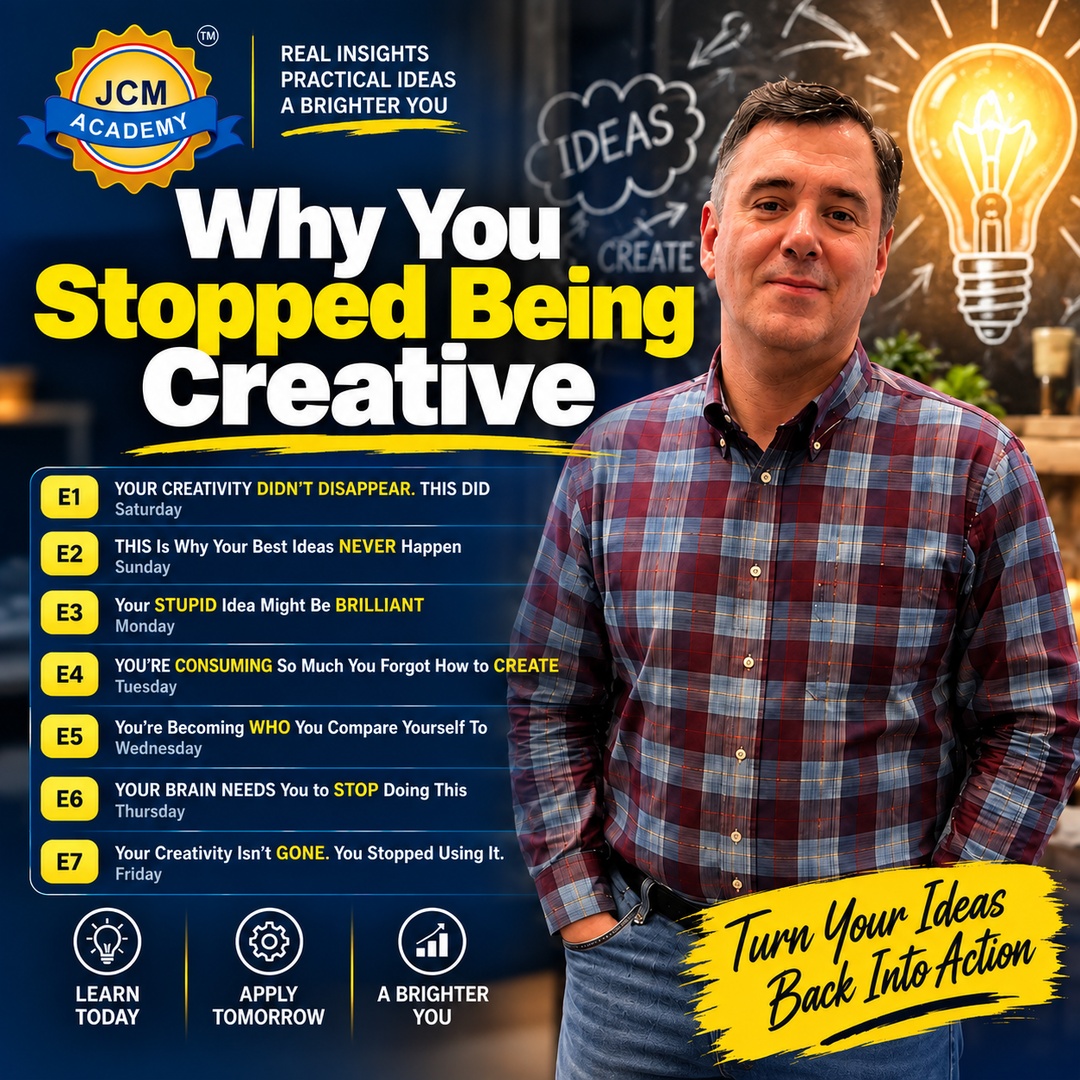
This week's Inspirations for Your Life explores the conditions that gradually weaken our relationship with creativity and the habits that can strengthen it again. Across seven connected conversations, we examine why creativity can seem to disappear, why promising ideas frequently remain trapped inside our heads, why ideas that initially sound ridiculous sometimes deserve further exploration, how constant consumption can suppress original thought, how comparison influences what we create and even who we become, why the brain needs periods without continuous stimulation, and why creativity becomes stronger when we stop waiting for inspiration and begin using it regularly.
The larger message is not that everyone needs to become an artist or spend every available hour pursuing creative projects. It is that imagination, curiosity, experimentation, and original thinking remain important throughout adulthood. The creative part of ourselves doesn't necessarily disappear as we get older, busier, or more responsible. Sometimes it simply receives less practice, less freedom, and less space than it once did.
Understanding that difference changes the question from "Where did my creativity go?" to "What would happen if I started using it again?"
YOUR CREATIVITY DIDN’T DISAPPEAR. THIS DID (S5) S39:E1 Saturday
When people remember being more creative earlier in life, they often focus on the creativity itself while overlooking the environment surrounding it. Children regularly experiment without requiring an economic justification for what they are doing. They draw pictures that nobody will purchase, build structures that will eventually be taken apart, invent games whose rules change halfway through playing them, ask questions adults may consider impractical, and imagine possibilities without first determining whether those possibilities are realistic. The activity does not need to produce a credential, generate revenue, improve a résumé, or attract an audience to be considered worthwhile.
As adulthood progresses, that environment changes substantially. Time becomes connected to responsibility, and responsibility encourages efficiency. Bills to pay, careers to manage, businesses to operate, families to support, homes to maintain, appointments to attend, messages to answer, and countless administrative tasks seem individually small but collectively consume significant portions of our lives. When time becomes scarce, we often cut activities that don't produce an obvious result first.
This is where creative space can disappear without creativity itself disappearing.
A person may still possess an extraordinary imagination but rarely encounter an opportunity to use it. Their days are structured around responding rather than exploring. They answer emails instead of asking new questions, solve established problems instead of imagining new possibilities, and move from one obligation to another without enough unstructured time for ideas to develop. Eventually, the mind becomes highly practiced at execution while becoming less practiced at exploration.
Curiosity can experience the same decline. Young people frequently ask questions without worrying whether those questions are efficient. Adults become much more selective because they have learned to prioritize information that appears immediately relevant. That skill is necessary, but when taken too far, it can narrow the range of material available to creative thought. Creativity often emerges from unexpected connections, and those connections become harder to make when we expose ourselves only to information directly related to what we already do.
Culture also tends to treat imagination as something we should eventually outgrow. Serious adults are expected to be practical, responsible, and realistic, which are valuable qualities, but practicality and imagination are not opposites. Some of the most practical solutions begin with someone imagining an alternative that did not previously seem realistic. Asking what else might be possible is not childish. It is fundamental to innovation.
Reconnecting with creativity therefore begins with examining what actually changed. Perhaps your imagination did not weaken because of age. Perhaps the amount of uninterrupted time available for imagination decreased. Perhaps curiosity became subordinate to efficiency. Perhaps experimentation became uncomfortable because mistakes now appear to carry greater consequences. Perhaps you began evaluating ideas according to whether they could produce money, attention, recognition, or professional advancement before allowing yourself to enjoy developing them.
Once those conditions are visible, you can change them deliberately. You do not need unlimited free time to become creative again. You need enough protected space for ideas to exist before they are required to prove their usefulness.
THIS Is Why Your Best Ideas NEVER Happen (S5) S39:E2 Sunday
Most people have had ideas they genuinely believed were worth pursuing but never developed. Some of those ideas disappeared entirely, while others remain in notebooks, documents, voice recordings, saved messages, or mental lists of things they plan to do eventually. There is nothing inherently wrong with deciding not to pursue every idea because time and resources are limited, and intelligent prioritization requires saying no. The problem begins when almost every idea remains permanently trapped in the planning stage.
One reason this happens is that an idea exists under ideal conditions until execution begins. In our imagination, the book is already coherent, the business already works, the presentation is polished, the project has an audience, the product functions correctly, and the finished result resembles exactly what we hoped to create. Reality introduces friction. The first paragraph is awkward. The prototype does not behave as expected. The recording requires another attempt. The plan costs more than anticipated. Something we assumed would take an hour takes an afternoon. The distance between our imagined result and our initial execution can suddenly become uncomfortable.
That distance is where many potentially valuable ideas are abandoned.
We often interpret the difficulty of execution as evidence that the idea itself was weak, when difficulty may simply mean creation is happening. A finished product conceals enormous amounts of revision, experimentation, discarded material, failed approaches, and ordinary work. When we encounter someone else's completed result, we see what survived the process rather than everything that happened during it.
Perfectionism makes this problem worse because it lets avoidance look responsible. We tell ourselves we are researching, planning, preparing, or waiting until circumstances improve. Sometimes that preparation is necessary, but preparation has no natural endpoint. There will always be another article to read, another expert to consult, another tool to acquire, another feature to consider, or another reason next month might be more convenient.
Eventually, execution requires accepting uncertainty.
The first version does not need to justify the entire idea. Its job is to provide information that thinking alone cannot provide. A rough draft reveals structural problems. A prototype reveals engineering problems. A conversation reveals whether another person understands the concept. A small test reveals whether assumptions hold up when they meet reality. Action produces feedback, and feedback allows an idea to evolve.
This is also why idea collection should never be confused with idea development. Maintaining an idea list is useful because inspiration often arrives at inconvenient moments, but collecting dozens of ideas can become another form of creative avoidance. The satisfaction of recording something new can replace the more demanding work of choosing something old and building it.
Creativity becomes more consequential when we learn to select ideas rather than merely accumulate them. Pick one. Determine what the smallest meaningful version looks like. Give it enough time to become imperfectly real. Then use what reality teaches you to determine what happens next.
Your best ideas may not be waiting for better inspiration. They may be waiting for you to tolerate the imperfect beginning required to discover what they can become.
Your STUPID Idea Might Be BRILLIANT (S5) S39 E3 Monday
Creativity requires a temporary willingness to entertain possibilities before deciding whether they deserve to survive. That can be difficult because adults become increasingly skilled at evaluation. Experience teaches us what tends to work, what usually fails, what customers expect, what colleagues will accept, what audiences respond to, and what established systems permit. This knowledge is valuable, but it can become restrictive when applied too aggressively in the earliest stages of an idea.
An unusual idea often sounds weak before you develop its context. It may violate an assumption that everyone else has accepted, combine concepts that are rarely connected, or propose a solution that initially appears inefficient. Because we cannot immediately see how the idea will work, we may classify it as ridiculous before investigating what made us think of it in the first place.
This is especially dangerous when self-judgment happens before anyone else is involved. Many creative ideas never encounter external rejection because their creators reject them privately. We imagine the criticism, embarrassment, confusion, or indifference we might receive and modify the idea until it feels safer. Sometimes we remove the very quality that made it worth exploring.
The alternative is not to assume every unusual idea is brilliant. Creativity without judgment produces endless possibilities but few useful outcomes. The important distinction involves timing. Idea generation and idea evaluation serve different functions, and trying to do both at once can keep each from working effectively.
During generation, the question can be expansive: What could we try? During evaluation, the question becomes selective: Which possibilities deserve additional investment? Separating those stages gives unconventional ideas enough time to reveal whether they contain something useful.
A seemingly ridiculous idea can also function as a bridge. Perhaps the idea itself will never be implemented, but exploring it exposes an assumption worth challenging. That challenge produces another idea, which leads to a practical experiment, which eventually becomes the solution. If the original thought had been rejected instantly, the sequence would never have begun.
Creative environments need room for this process. Teams that claim to value innovation while humiliating people for imperfect suggestions will quickly teach everyone to remain quiet. Individuals can create the same hostile environment inside their own minds when every unusual thought is immediately attacked.
Allow an idea to be strange before requiring it to be sensible. Ask what attracted you to it, what problem it might solve, what assumption it challenges, and whether some smaller part deserves experimentation. The answer may still be no, but that conclusion should come from thoughtful evaluation, not automatic embarrassment.
YOU’RE CONSUMING So Much You Forgot How to CREATE (S5) S39 E4
The modern information environment has made consumption nearly effortless. A person can wake up and begin receiving other people's ideas before getting out of bed. News, social media, email, videos, podcasts, music, messages, articles, notifications, and entertainment can accompany almost every part of the day. Even activities that once created natural pauses have become opportunities for additional input.
This access has tremendous value. We can learn skills that once required specialized education, hear perspectives from people around the world, study experts directly, and discover subjects we might never have encountered otherwise. The problem is not consumption itself. The problem is the disappearance of the boundary between consuming and creating.
When every available space is filled with input, our own thoughts constantly compete with somebody else's.
Consider how frequently quiet moments are now eliminated. A person waiting for an appointment checks a phone. Someone walking somewhere listens to a podcast. A few minutes before a meeting become an opportunity to scroll. Lunch includes a video. Exercise includes another stream of information. Even falling asleep may involve content playing in the background.
The brain is constantly receiving but rarely left alone to reorganize what it has received.
Creative thought requires some degree of processing. Information needs opportunities to collide with experience, memory, curiosity, and unrelated ideas. We need moments when the question is not "What else can I consume?" but "What do I think about what I have already consumed?"
Constant exposure to polished work creates another difficulty. We begin comparing our private creative process with other people's public outcomes. We see the published book rather than the abandoned drafts, the successful company rather than the failed experiments, the polished presentation rather than the rehearsals, and the edited video rather than everything removed during production. Our unfinished work naturally looks inferior because we compare it with finished work.
Reducing consumption does not require rejecting technology. It means establishing boundaries that preserve the distinction between input and output. Perhaps the first hour devoted to a project happens before checking what everyone else has done. Perhaps an idea is developed independently before searching for similar approaches. Perhaps a walk happens without headphones. Perhaps twenty minutes previously devoted to scrolling becomes twenty minutes of writing, sketching, designing, experimenting, or thinking.
A healthier relationship with information asks what happens after we learn something. Do we merely save it, or do we apply it? Do we repeat someone else's interpretation, or do we develop our own? Do we collect inspiration indefinitely, or does some of that inspiration eventually become creation?
The world does not suffer from a shortage of things for you to consume. Your challenge is preserving enough attention to create something of your own.
You’re Becoming WHO You Compare Yourself To (S5) S39:E5 Wednesday
Comparison is usually discussed as a confidence problem, but its influence reaches much further. The people we repeatedly compare ourselves with can gradually influence our goals, standards, aesthetic preferences, definitions of success, and understanding of what is worth creating. If we are not careful, we can spend years pursuing somebody else's definition of achievement without ever consciously deciding that it belongs to us.
This happens subtly because comparison frequently begins as learning. We identify people who are successful in areas that interest us and study what they do. There is nothing wrong with that. Learning through observation is one of the fastest ways to improve, and virtually every accomplished person has been influenced by teachers, mentors, peers, competitors, and predecessors.
The problem emerges when influence begins replacing identity.
If we spend enough time studying what receives attention, we can begin creating primarily for attention. If we constantly monitor what performs well, we can start evaluating ideas by their anticipated metrics before judging whether they are meaningful. If we repeatedly compare ourselves with people whose priorities are different from ours, we can gradually adopt those priorities simply because they are visible.
Social platforms intensify this because comparison is no longer occasional. We can compare ourselves with hundreds of people before breakfast, many of whom have carefully selected which portions of their work and lives we are allowed to see. The resulting comparison is not merely unfair. It can actively reshape what we think we should want.
Creative independence requires learning without surrendering direction. You can admire someone's discipline without copying their career. You can study someone's communication without adopting their personality. You can learn from another creator's technique while developing a voice that sounds unmistakably like your own.
This becomes particularly important when something original initially performs poorly. Familiarity has an advantage because audiences immediately understand what they recognize. Something genuinely different may require explanation, repetition, or time before people know what to do with it. If you evaluate every creative decision through immediate comparison, you may abandon originality before it has time to develop.
The objective is not to become completely unaffected by other people because that would be unrealistic. The objective is to stay aware of which influences you allow into your creative process and whether they help you become more capable or merely more similar.
Eventually, creativity requires an answer to a deeply personal question: What would you create if you were not trying to become somebody else?
YOUR BRAIN NEEDS You to STOP Doing This (S5) S39:E6 Thursday
A brain that is constantly occupied does not necessarily become more creative because creativity depends on more than the amount of information available. It also depends on the ability to process information, notice patterns, form associations, and allow ideas to develop without being interrupted by another demand for attention.
Modern life makes that difficult because interruption has become normal. Notifications appear while we are working. Messages arrive during conversations. Multiple browser tabs remain open. Entertainment accompanies routine tasks. Even when nothing external interrupts us, we may interrupt ourselves because the habit of checking has become automatic.
The result can be a mind that is constantly active but rarely spacious.
Some of our most useful ideas arrive when direct concentration has temporarily stopped. A solution appears while walking, showering, driving, exercising, gardening, cleaning, or doing something unrelated to the original problem. This does not mean those activities contain magical creative properties. They reduce deliberate focus enough for other associations to emerge.
Boredom can play an important role here. For generations, boredom was an unavoidable part of daily life. People waited without unlimited entertainment, traveled without constant connectivity, and experienced periods when nothing immediately demanded attention. Technology has made it possible to eliminate many of those moments, but eliminating boredom also eliminates one of the conditions that can encourage the mind to generate its own stimulation.
When nothing interesting is happening outside us, we are more likely to create something interesting inside us.
Rest is equally important. Chronic exhaustion narrows cognitive resources. A tired person can often continue completing familiar tasks through discipline, but creative exploration requires energy for uncertainty. It is harder to imagine alternatives when the mind is focused primarily on getting through the next obligation.
This is why creative performance cannot be separated from recovery. Sleep, physical movement, time away from screens, unstructured thinking, and genuine downtime may seem unrelated to productivity, but they support the mental conditions from which better work can emerge.
The challenge is that stopping can feel irresponsible when we are accustomed to measuring value through visible activity. A person sitting quietly appears to be accomplishing less than someone answering messages, watching a tutorial, or completing another task. Yet not every important cognitive process produces an immediate visible result.
Sometimes the most productive thing we can do for a difficult problem is stop attacking it for a while.
Creating more mental space does not mean becoming passive. It means understanding that output depends partly on processing. If your mind never gets an opportunity to finish one thought before receiving another, adding more information may not produce the breakthrough you need.
Sometimes your brain needs you to stop feeding it and give it enough quiet to show you what it already knows.
Your Creativity Isn’t GONE. You Stopped Using It (S5) S39:E7 Friday
Creativity becomes easier through use because creative thinking contains skills that respond to repetition. The more frequently we generate ideas, the less intimidating idea generation becomes. The more frequently we experiment, the more comfortable we become with uncertainty. The more projects we complete, the better we get at moving through the uncomfortable middle, where initial enthusiasm has faded, but the finished result has not yet appeared.
That is why feeling creatively stuck doesn't necessarily mean something is wrong. If you have spent months or years focusing almost entirely on execution, responsibility, and consumption, creative work may feel awkward at first. That awkwardness doesn't prove creativity has disappeared. It may simply be evidence that a neglected ability is being used again.
The best response is to lower the threshold for beginning.
Create something small today rather than designing an elaborate plan for becoming creative next month. Write one page. Sketch one concept. Record one idea. Rearrange a room. Develop a new solution to an ordinary inconvenience. Cook something differently. Take photographs from an unfamiliar perspective. Build something nobody needs. Explore a subject unrelated to your profession.
The purpose is not immediate excellence. The purpose is reestablishing the habit of creation.
This also changes our relationship with inspiration. Many people wait to feel inspired before beginning, but inspiration is unreliable when treated as a prerequisite. Action can generate inspiration because starting exposes us to possibilities that were invisible while we waited. A sentence creates another sentence. A sketch suggests a different shape. A prototype exposes a problem whose solution becomes more interesting than the original idea.
Regular creative practice therefore creates more opportunities for inspiration to appear.
Curiosity needs similar maintenance. Continue learning things outside your normal world. Speak with people whose experiences differ from yours. Visit unfamiliar places. Explore subjects that do not obviously contribute to your career. Read something because the subject fascinates you, not because you need the information. New experiences provide additional raw material for imagination to build connections.
Responsibility should not eliminate curiosity. In fact, experience can make curiosity more valuable because adults possess more knowledge with which new information can interact.
Another important step is removing the requirement that every creative activity become profitable. Entrepreneurs and professionals can easily fall into this pattern because they are trained to identify opportunities. An interesting idea immediately becomes a potential product, service, program, piece of content, or revenue stream. That ability can be useful, but creativity also needs places where commercial evaluation is temporarily absent.
Not every idea needs to become a business. Not every hobby needs a monetization strategy. Not everything you create needs an audience.
Creating something simply because it interests you can restore a relationship with imagination that constant performance has weakened.
Idea management matters too. Keep a list of ideas, but build a system for returning to it. Periodically review what you have collected and ask which ideas still create energy. Select some for development rather than allowing the list to become a museum of things you never attempted.
Then finish some of what you start.
Finishing teaches lessons that beginning cannot. It requires prioritization, revision, compromise, problem-solving, and the willingness to declare something complete even though another improvement is always possible. People who constantly begin but rarely finish can become addicted to the excitement of possibility while avoiding the discipline of completion.
Sharing is another decision that requires judgment. Some ideas grow stronger when they meet other perspectives, while fragile early ideas can be damaged by criticism before they develop enough to withstand it. Learn when collaboration will strengthen an idea and when it needs more private development.
Most importantly, continue creating even when nobody notices.
An audience can amplify creative work, but an audience doesn't make the act creative. Metrics do not determine whether exploration was worthwhile. Recognition does not grant permission to imagine.
Your creativity belongs to you before it belongs to anyone watching.
The creative person you remember may still be there, waiting beneath years of routines, responsibilities, comparison, constant consumption, and the belief that creativity should arrive automatically. You don't need to discover that person through endless analysis. Sometimes that person needs an assignment.
Make something.
Then make something else.
Over time, what initially felt difficult begins feeling familiar again because creativity becomes part of your life rather than something you keep waiting to rediscover.
Creativity Returns When You Give It Somewhere to Go
Across this week's seven conversations, a consistent explanation emerges for why so many intelligent, capable, accomplished people begin believing they are no longer creative. Their creativity may not have vanished at all. The environment around it changed. Unstructured time decreased, responsibilities expanded, consumption increased, comparison became constant, perfectionism made experimentation feel dangerous, and the pressure to make every activity useful removed many of the spaces where creativity once operated naturally.
Recognizing those conditions is important because it replaces a fixed conclusion with a solvable problem. If creativity is something you either possess or permanently lose, there is little reason to act. If creativity is a capacity influenced by practice, environment, curiosity, attention, and behavior, then there are many ways to strengthen your relationship with it.
The first involves reclaiming space. Creativity cannot compete indefinitely with a schedule in which every minute has already been assigned. That does not mean everyone needs hours of daily free time. Even small periods can become valuable when you genuinely protect them from incoming demands. Twenty uninterrupted minutes of creating can produce more original thought than two hours of distracted effort divided among notifications, messages, videos, and other people's ideas.
The second involves becoming more comfortable with imperfect beginnings. Creative people do not avoid bad ideas. They generate enough ideas that some eventually become good ones. They understand that the first attempt is information, not a verdict. They allow projects to develop through revision instead of expecting imagination to deliver a polished result instantly.
The third involves reconsidering consumption. We should absolutely continue learning, reading, listening, studying, and exposing ourselves to excellent work, but consumption becomes more valuable when paired with transformation. Ask what you think about what you learned. Challenge it. Apply it. Combine it with something from another field. Explain it differently. Build on it rather than merely storing it.
The fourth involves protecting identity from comparison. There will always be someone further ahead, more visible, more polished, better funded, more experienced, or apparently more successful. Their existence does not invalidate your perspective. Other people can show what is possible without becoming templates for who you are required to become.
The fifth is to give your brain enough quiet for ideas to connect. Constant stimulation can feel productive while making original thinking more difficult. A mind that is never left alone is always processing someone else's agenda. Silence, walking, boredom, rest, and ordinary moments without additional content can create conditions in which our own thoughts have room to develop.
Finally, creativity needs use. We can read endlessly about becoming creative, organize the perfect creative workspace, buy equipment, collect ideas, watch successful creators, and wait for inspiration. Still, none of those activities substitutes for making something.
Creative confidence comes partly from evidence, and the strongest evidence comes from action. You create something imperfect and discover that nothing terrible happened. You improve it and realize improvement was possible. You finish something and understand the process more clearly. You try again with better judgment. Eventually, creativity stops feeling mysterious because you have developed a working relationship with it.
That relationship can influence far more than traditionally creative projects. Someone who practices imagination becomes better prepared to consider alternatives when a business problem appears. Someone who remains curious becomes more likely to notice information outside their usual field that could solve a problem inside it. Someone comfortable with experimentation can adapt more effectively when circumstances change. Someone who can tolerate imperfect beginnings is more willing to pursue opportunities with uncertain outcomes.
Creativity therefore belongs alongside other adult capabilities, not outside them. Responsibility and imagination can coexist. Discipline can strengthen creativity rather than restrict it. Structure can protect creative time. Experience can provide richer material for new ideas. Even failure can contribute by giving us information we didn't have before.
The real danger is not that adulthood inevitably removes creativity. The danger is accepting that assumption and therefore giving creativity no opportunity to prove otherwise.
You may have spent years using your mind primarily to execute what needed to be done. You may have become extraordinarily effective at solving immediate problems while rarely permitting yourself to explore problems nobody asked you to solve. You may have consumed so much excellent work that producing something imperfect now feels embarrassing. You may have compared yourself with people whose work has been developing for decades and concluded that your first attempts are evidence you lack ability.
None of those conclusions has to become permanent.
Permit yourself to become a beginner again in some area of your life. Ask questions that do not have immediate practical value. Follow curiosity beyond the boundaries of what you already know. Create before you know exactly what the creation will become. Let ideas remain strange long enough to see whether something useful is hiding inside them. Occasionally reduce external input so your own thinking has room to emerge.
Then repeat the process.
Creativity is not strengthened by one inspirational weekend followed by another year of neglect. It becomes part of life when experimentation, curiosity, and creation appear regularly enough that they stop feeling unusual.
Some days, ideas still won't come easily. Projects will still fail, drafts will still disappoint, experiments will still lead nowhere, and concepts will still look worse in reality than they did in imagination. Those experiences are not evidence that creativity has disappeared. They are evidence that you are participating in the creative process rather than merely observing it.
The person who creates consistently develops something far more useful than the person who waits indefinitely for the perfect idea: a capacity to work with whatever idea appears next.
That is where the shift happens. Creativity stops being something you hope will return and becomes something you practice. Curiosity stops being nostalgia for who you used to be and becomes part of how you engage with life now. Ideas stop accumulating as possibilities and begin becoming experiments, projects, solutions, conversations, and finished work.
You do not need to recover every quality of the person you were years ago. You have knowledge now that you didn't have then, experiences you couldn't have imagined, skills you hadn't yet developed, and perspectives only time could provide. The opportunity is to combine that accumulated experience with the willingness to imagine that may once have come more naturally.
Your creativity is not valuable because every idea will work. It is valuable because it lets you see that what exists today isn't the only thing that could exist tomorrow.
And if creativity has felt distant lately, the most important step may also be the simplest one: stop waiting for proof that you are still creative and give yourself something to create.
Have you read John’s Book Drained to Driven?
Did you know John has a weekly blog? Explore it to find insights to improve your life.
Check out John’s Author Talks and other events around the Country too!
Leave A Comment
Please login to add a comment!
Comments (0)