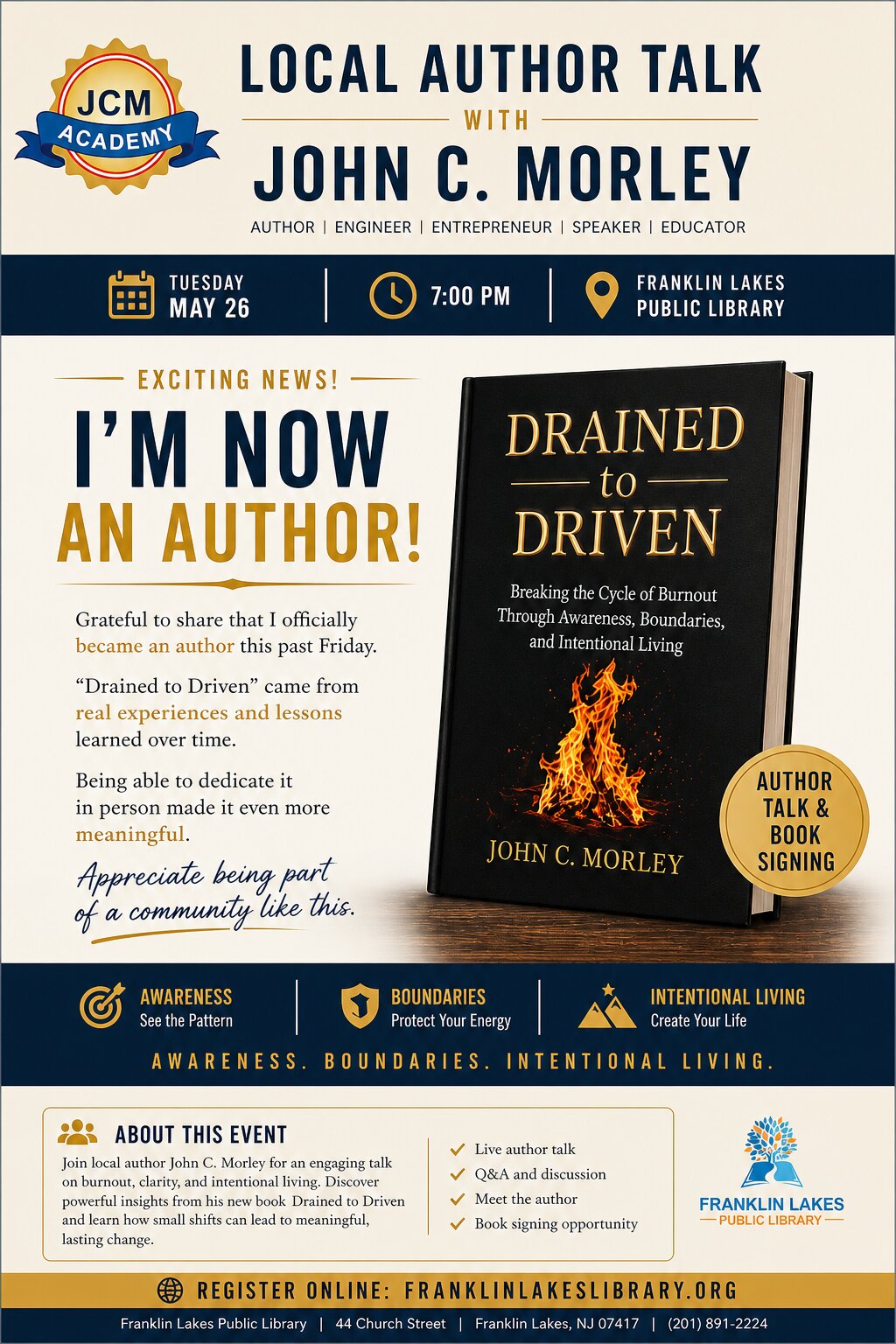
Author Talk & Book Signing | Franklin Lakes Public Library | May 26
Website Link
Franklin Lakes Public Library
Drained to Driven Author Talk & Book Signing
Franklin Lakes Public Library | May 26 | 7:00 PM
There is a particular experience that tends to develop quietly, almost imperceptibly at first, and yet has a profound impact on how people experience their lives over time. It is not something that announces itself with urgency. It does not interrupt daily responsibilities or force immediate attention. In fact, one of the reasons it persists for so long is because everything on the surface appears to be functioning as expected.
Work is getting done. Responsibilities are being met. Life continues to move forward in a structured and predictable way.
And yet, beneath that structure, something begins to shift.
It is subtle. It is difficult to define. It does not feel like failure, and it does not feel like crisis. Instead, it feels like a quiet disconnect between what you are doing and how you experience doing it. What once felt purposeful begins to feel routine. What once felt like progress begins to feel like repetition. What once created energy begins to feel neutral.
This is the space that Drained to Driven explores, and it is the foundation of this upcoming author talk and book signing at the Franklin Lakes Public Library.
This event is not built around motivation, nor is it designed to provide quick solutions. It is built around understanding. It is about recognizing the patterns that shape how people experience progress, identifying where those patterns begin to shift, and exploring what it actually means to move forward in a way that feels aligned, intentional, and sustainable.
The Gradual Nature of Disconnection
One of the most important aspects of this experience is how gradually it develops. People rarely feel stuck all at once. There is no clear starting point, no obvious moment where everything changes. Instead, it is the result of small, incremental shifts that accumulate over time.
A decision made out of convenience rather than intention.
A priority adjusted to meet expectations rather than personal direction.
A routine followed simply because it has always been there.
Individually, these choices seem insignificant. They do not raise concern. They do not signal a problem. But collectively, they begin to shape a different trajectory.
The result is not a dramatic loss of direction, but a quiet drift away from it.
Because this drift happens gradually, it does not immediately trigger awareness. Life continues. Progress appears to be happening. There are no obvious failures to correct. And so the pattern continues, often for longer than it should.
Over time, however, the internal experience begins to change.
Energy may feel slightly lower, even if productivity remains the same. Focus may require more effort, even for tasks that were once simple. Engagement may decrease, not to the point of disinterest, but enough that things feel less meaningful than they once did.
This is not burnout in the traditional sense. It is not exhaustion or overwhelm.
It is something more subtle.
It is the early stages of misalignment.
The Illusion of Progress
One of the most common factors that contributes to this experience is the way progress is often defined.
In many environments, progress is equated with activity. The more you do, the more productive you are perceived to be. Full schedules, completed tasks, and consistent output create the appearance of forward movement.
But activity alone does not guarantee meaningful progress.
Without a clear sense of direction, effort can become disconnected from outcome. People can work hard, stay busy, and still feel like they are not getting anywhere that matters to them.
This creates a unique form of frustration.
Not because there is a lack of effort, but because that effort is not producing the sense of movement that was expected. Over time, this disconnect leads to uncertainty. Decisions that once felt straightforward begin to feel more complex. Small choices begin to carry more weight.
And gradually, the sense of clarity that once guided those decisions begins to fade.
Why More Effort Is Not the Answer
When people encounter this experience, their first instinct is often to increase effort.
Work harder.
Stay more disciplined.
Push through resistance.
This approach is understandable. In many situations, effort does lead to results. But in this case, it often creates the opposite effect.
When actions are not aligned with direction, additional effort amplifies the misalignment. Instead of creating progress, it creates fatigue. Instead of increasing clarity, it reinforces confusion.
This is why many individuals feel like they are working harder than ever but not experiencing the results they expect.
The issue is not effort.
The issue is alignment.
The Role of Awareness in Changing Direction
The shift that begins to change this experience does not come from doing more. It comes from seeing more clearly.
Awareness is the foundation of that shift.
When you begin to observe how your time is being used, how decisions are being made, and how patterns are shaping your daily experience, you create the opportunity for change. Not immediate change, but meaningful change.
This process is not about identifying a single problem and fixing it. It is about recognizing how a series of small, consistent patterns have led to a particular outcome.
Once those patterns become visible, they can be adjusted.
And it is within those adjustments that direction begins to change.
What This Event Will Explore in Depth
This author talk is designed to move beyond surface-level explanations and into a deeper exploration of how people experience progress.
The discussion will examine:
How the feeling of being stuck develops gradually over time
Why stability can sometimes conceal deeper misalignment
The difference between structured activity and meaningful movement
How internal and external expectations shape decision-making
The relationship between clarity, energy, and focus
Why awareness is a prerequisite for sustainable change
How small, intentional adjustments can create long-term direction
These topics are not presented as abstract concepts. They are grounded in real-world experience and framed in a way that is both practical and applicable.
What Attendees Will Walk Away With
Participants will leave with more than just information. They will leave with a different perspective on how they approach their own direction.
They will gain:
A clearer understanding of why their current experience feels the way it does
Insight into the patterns that may be influencing their decisions
A deeper awareness of how alignment impacts energy and engagement
A framework for evaluating whether their current direction is meaningful
A practical way to begin making more intentional choices moving forward
The goal is not to provide a set of instructions. It is to provide clarity.
And from clarity, better decisions follow.
The Psychological Shift That Often Goes Unnoticed
As this experience continues, there is often a deeper psychological shift that begins to take place.
When progress feels unclear or inconsistent, people begin to adjust their expectations. Not consciously, but gradually. What once felt possible begins to feel less attainable. Goals that once created excitement may begin to feel unrealistic.
This adjustment is subtle.
It does not involve abandoning goals entirely. Instead, it involves placing them slightly further out of reach, focusing instead on what feels manageable and predictable.
Over time, this creates a narrowing effect.
Options that once felt available begin to feel limited. Paths that once seemed possible begin to feel unlikely. And eventually, the familiar path becomes the default, not because it is the best option, but because it feels the most certain.
This is one of the ways in which people remain in this state longer than they should.
Not because they lack capability, but because their perception of what is possible has quietly changed.
Why This Event Matters Right Now
In an environment where constant activity is often encouraged, there is very little space to step back and evaluate direction.
Most people are focused on keeping up.
Keeping up with responsibilities.
Keeping up with expectations.
Keeping up with the pace of their environment.
But keeping up is not the same as moving forward.
This event creates a space to pause, reflect, and reconsider how movement is being defined.
It is not about slowing down.
It is about ensuring that the direction you are moving in is actually meaningful.
About Drained to Driven
Drained to Driven is a reflection on the experience of burnout, misalignment, and the process of rebuilding clarity.
It does not rely on motivation or quick solutions. Instead, it explores how people gradually lose connection with what matters and how that connection can be rebuilt over time.
The book examines:
The relationship between effort and alignment
The role of awareness in decision-making
The patterns that influence long-term outcomes
The process of reconnecting with meaningful direction
Its message is grounded in a simple idea:
Progress is not defined by how much you do.
It is defined by how aligned your actions are with what truly matters.
About John C Morley
John C Morley brings decades of experience across engineering, business, marketing, and leadership. As a keynote speaker and educator, his work focuses on helping individuals and organizations recognize the patterns that influence performance and direction.
His approach is not based on generic advice. It is grounded in awareness, clarity, and intentional decision-making.
Through his speaking engagements, he works with teams and organizations looking to improve focus, rebuild momentum, and move forward with greater alignment.
Event Details
Franklin Lakes Public Library
May 26
7:00 PM
Open to the public
Attendees will have the opportunity to:
Attend the live author talk
Engage in discussion
Ask questions
Meet the author
Participate in a book signing
Final Reflection
Feeling stuck is not a failure.
It is not a sign that something is broken.
It is a signal that something is no longer aligned in the way it once was.
When that signal is understood, it creates the opportunity for change.
Not through pressure.
Not through force.
But through clarity.
And once clarity begins to take shape, movement follows.
This event is an opportunity to begin that process.