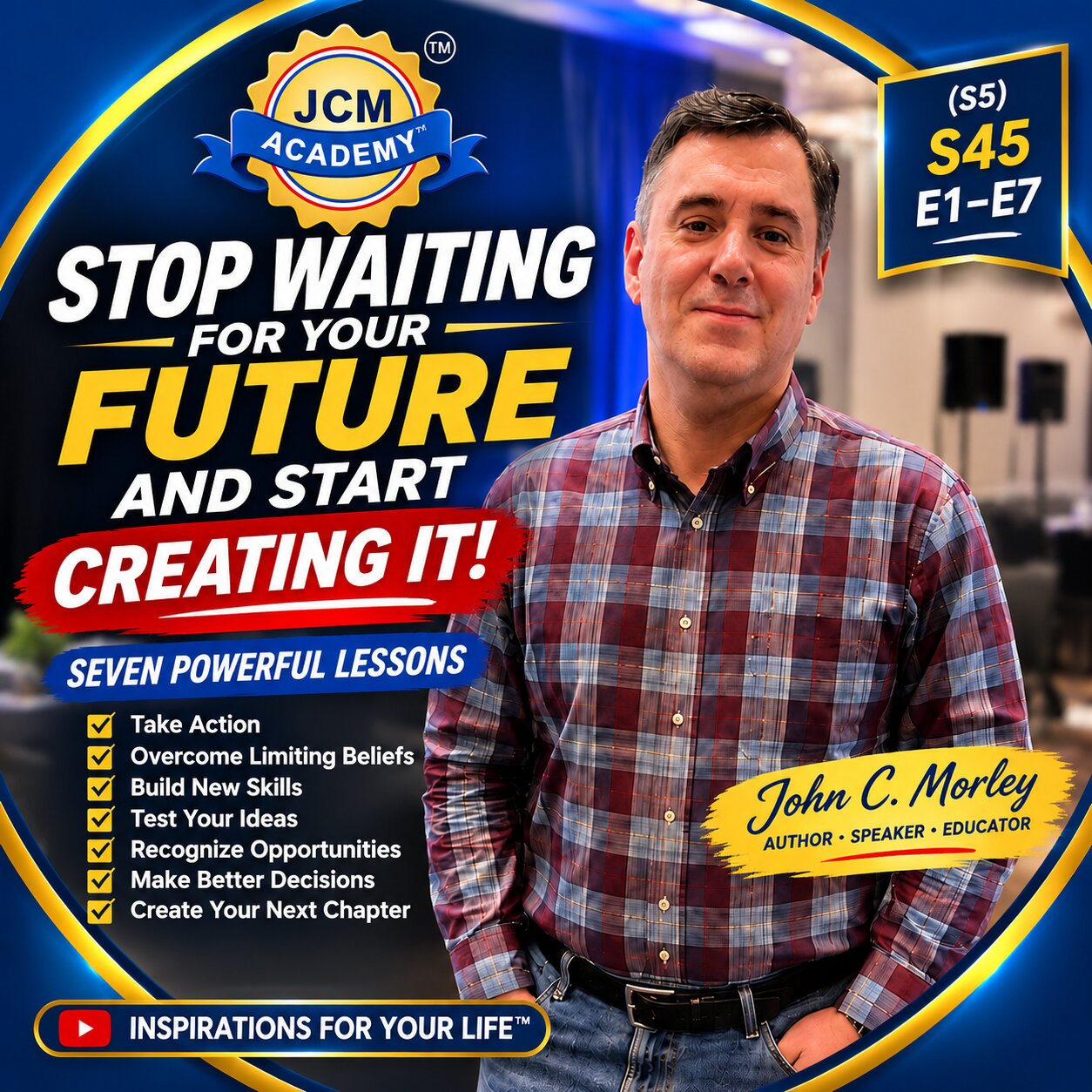
Stop Waiting for Your Future and Start Creating It: Seven Powerful Lessons (S5) S45 E1–E7
Your Future Is Not Waiting for the Perfect Moment
How many times have you told yourself that you will begin something important when the timing is right? Perhaps you are waiting for greater confidence, a better opportunity, additional resources, or reassurance that your decision will work out. You might even be waiting for a sign that tells you it is finally time to move forward.
The problem is that the sign you are waiting for may never arrive.
Every day, people postpone meaningful decisions because they believe clarity must come before action. They convince themselves that once they feel completely prepared, the next step will become obvious. Yet meaningful progress rarely happens under perfect conditions. More often, it begins when someone recognizes that uncertainty is part of the journey and decides to move forward responsibly anyway.
This week's Inspirations for Your Life series explores a powerful question: Are you actively creating your future, or are you waiting for circumstances to create it for you?
Across seven episodes, John C. Morley examines the relationship between action, identity, possibility, skill development, experimentation, awareness, and the decisions that shape tomorrow.
These subjects are connected by a central principle: Your future is influenced by what you consistently choose to do in the present.
This does not mean every outcome is within your control. Economic conditions, health, family responsibilities, unexpected setbacks, and other circumstances can affect the opportunities available to you. However, recognizing those limitations does not eliminate the value of purposeful action. It makes thoughtful decisions, preparation, and adaptability even more important.
The goal is not to pretend that every obstacle can be overcome through positive thinking. It is to understand where you have influence and use that influence wisely.
If you have been feeling disconnected from your goals, consider exploring how to stop living on autopilot and take back control of your life. Becoming more intentional begins with recognizing the difference between merely staying occupied and making meaningful progress.
Let's examine the seven lessons that can help you move from waiting to building.
Episode 1: You're WAITING for a SIGN That Isn't Coming! (S5) S45 E1
Stop Waiting for Permission to Begin
One of the most common obstacles to progress is the belief that something external must happen before we can take action.
We wait for someone to recognize our potential. We wait for circumstances to become easier. We wait for the perfect business opportunity, the ideal relationship, or the moment when we finally feel confident enough to pursue an important goal.
Waiting can feel responsible because it resembles preparation. Sometimes patience genuinely is the right decision. However, there is a meaningful difference between waiting for information you actually need and postponing action because uncertainty makes you uncomfortable.
Imagine someone who wants to launch a business. They spend months researching names, studying competitors, designing a logo, and imagining what success might look like. These activities can be valuable, but none automatically establishes whether customers want the proposed service.
At some point, the individual must move beyond preparation and begin testing whether the idea has practical potential.
The same principle applies to personal development. Someone who wants to improve their communication skills cannot gain experience exclusively by reading about communication. They need opportunities to practice, listen, make adjustments, and learn from actual interactions.
Preparation should support action, not become a permanent substitute for it.
Why Waiting Can Become a Habit
Waiting often offers temporary emotional protection. If you never begin, you do not have to face the possibility of an imperfect result. You can preserve the idea that success would be possible under better circumstances without testing that belief.
Unfortunately, this protection comes at a cost. Opportunities may change, skills remain undeveloped, and the distance between your intentions and your actions grows.
The answer is not to make reckless decisions. It is to identify a reasonable first step that fits your circumstances.
For example, before leaving a stable job to start a company, you might interview prospective customers, build a small demonstration, or evaluate your financial requirements. Before committing to an expensive educational program, you might investigate prerequisites, speak with advisors, or complete an introductory course.
These steps allow you to make progress while managing risk.
Replace the Search for Signs With Better Questions
Instead of asking whether the universe is giving you permission, consider asking yourself:
- What specifically am I waiting for?
- Is that information necessary for a responsible decision?
- What can I accomplish with the resources available today?
- What is the smallest useful step that would provide meaningful feedback?
These questions redirect your attention toward choices you can evaluate.
You do not need absolute certainty to take every step. You need enough information to choose an appropriate action and enough flexibility to adjust when you learn something new.
As discussed in why waiting for your life to change can keep you stuck, progress requires participation. Your circumstances may not change simply because you hope they will.
The takeaway: Stop expecting an external signal to make every important decision for you. Develop the judgment to recognize when you have enough information to begin.
Episode 2: PAST Is NOT Your IDENTITY! (S5) S45 E2
Your History Matters, but It Does Not Have to Define Every Future Choice
Everyone carries a history of accomplishments, disappointments, relationships, decisions, and experiences. These events influence how we interpret the world and how we respond to challenges.
But an important distinction exists between acknowledging your past and treating it as a permanent definition of who you are.
Perhaps you made a poor financial decision years ago. Maybe you struggled academically, experienced a failed business venture, or remained in a relationship that no longer supported your well-being.
Those experiences deserve honest reflection. They may reveal mistakes that need correction, responsibilities that must be addressed, or patterns worth understanding.
However, they do not automatically determine your future capabilities.
A previous failure is evidence that something did not work under particular conditions. It is not proof that every future attempt will fail.
The Danger of Turning Experiences Into Labels
People sometimes describe themselves through statements that leave little room for growth.
"I'm terrible with money."
"I've never been good at school."
"I'm not a leader."
"I'm the kind of person who always gives up."
These statements may reflect genuine frustrations, but they also turn past experiences into fixed personal identities.
A more useful approach is to describe the behavior or difficulty precisely.
Instead of saying you are bad with money, you might recognize that you have not consistently maintained a budget or monitored expenses. Instead of assuming you cannot succeed academically, you might identify specific study methods, time constraints, or subjects that require additional support.
This shift matters because behaviors and systems can often be changed more directly than vague judgments about personal worth.
You cannot rewrite what happened, but you can change what you learn from it and how you respond going forward.
Accountability and Growth Belong Together
Moving beyond the past does not mean denying responsibility.
If your decisions harmed someone, accountability may require an apology, restitution, changed behavior, or accepting that trust must be rebuilt over time.
If an earlier strategy failed, growth may require acknowledging the mistakes involved rather than blaming circumstances alone.
The goal is neither self-condemnation nor avoidance. It is accurate understanding followed by constructive action.
For a deeper exploration, read when your past still controls your present. The central challenge is learning how to carry useful lessons forward without allowing old experiences to dictate every new decision.
Build Evidence of the Person You Are Becoming
Identity is reinforced by repeated behavior.
If you want to become more dependable, practice keeping commitments. If you want to become a stronger communicator, work on listening and explaining ideas clearly. If you want to become more resilient, develop practical ways to respond to setbacks.
These changes rarely happen through a single dramatic moment. They develop through repeated choices.
You may still remember earlier mistakes. You may still encounter people who associate you with an older version of yourself. But their expectations do not have to become the standard by which you evaluate every future possibility.
The takeaway: Respect your history, accept responsibility where appropriate, and create new evidence of who you are becoming.
Episode 3: What If You're WRONG About What's POSSIBLE?! (S5) S45 E3
Challenge the Assumptions That Limit Your Options
Not every limitation is imaginary. Some obstacles are financial, physical, legal, technical, or structural. Ignoring those realities can lead to costly mistakes.
Yet people also restrict themselves through assumptions they have never properly examined.
They decide a career change is impossible because they are established in another field. They assume nobody would purchase their service because similar businesses already exist. They conclude that a particular skill is beyond their ability because they struggled with it years earlier.
These beliefs can feel like facts even when they are based on incomplete evidence.
The question is not whether you should believe anything is possible. The more useful question is whether your current understanding of what is possible is accurate.
Separate Facts From Predictions
Suppose you want to pursue an advanced degree while managing professional responsibilities.
A factual constraint might be that a required course meets at a particular time. Another might be the cost of tuition or the number of credits necessary to graduate.
A prediction would be that you could never succeed because you have been away from formal education for many years.
The constraints require planning. The prediction requires examination.
Could you begin with one course? Are alternative schedules available? What preparation would help you succeed? What financial support or institutional resources might apply?
By asking specific questions, you replace a broad assumption with information you can evaluate.
This approach is equally valuable in entrepreneurship. Before concluding that a market has no room for another provider, investigate customer needs, service gaps, purchasing behavior, and the value you could realistically deliver.
Curiosity Creates Better Decisions
Curiosity does not guarantee success. It improves the quality of your investigation.
When you approach a challenge with the assumption that you already know the answer, you may overlook evidence that contradicts your expectations.
When you approach it with disciplined curiosity, you become more willing to investigate alternatives.
Ask what evidence supports your belief. Consider whether that evidence is current. Look for examples that challenge your assumptions, while being careful not to treat exceptional success stories as proof that everyone can achieve identical results.
The purpose is not to become unrealistically optimistic. It is to avoid being unnecessarily pessimistic.
In why some people keep growing while others stay stuck, the relationship between learning, perspective, and development offers a useful extension of this idea.
Conduct a Possibility Audit
Choose one goal you have dismissed as unrealistic.
Write down the reasons you believe it cannot happen. Then classify each reason as a verified constraint, an assumption, a resource gap, or an unanswered question.
For verified constraints, consider whether there are lawful and practical alternatives. For resource gaps, determine what would be required to close them. For assumptions, identify evidence that could confirm or challenge them.
This exercise may reveal that some goals genuinely are not feasible under present circumstances. That is useful information.
It may also reveal that an opportunity you rejected deserves another look.
The takeaway: Do not confuse what you currently believe with everything that can be demonstrated to be true.
Episode 4: The SKILL You're MISSING Could CHANGE Everything! (S5) S45 E4
Your Next Breakthrough May Require a New Capability
People frequently focus on external obstacles when progress slows.
They may believe they need more customers, better connections, greater recognition, or a larger budget.
Sometimes those needs are real. At other times, the most significant limitation is a skill that has not yet been developed.
Consider an entrepreneur who provides excellent services but struggles to explain their value to prospective customers. Their technical competence may be strong, but weak communication or sales skills could prevent potential clients from understanding the benefits.
Another individual might communicate effectively but struggle to manage projects, estimate costs, or organize priorities.
In each situation, developing a specific capability may create opportunities that were previously difficult to access.
Identify the Actual Bottleneck
Before enrolling in another course or purchasing additional training, determine what is preventing progress.
If your goal is to grow a business, examine the process from initial customer interest through completed sales and service delivery.
Are people finding your business? Do they understand what you offer? Are inquiries turning into appointments? Are appointments becoming paying customers? Can you deliver consistently and profitably?
Different weaknesses require different solutions.
Someone who needs better customer discovery skills may not benefit from another advanced technical certification. Someone whose primary challenge is service delivery may not need more advertising until operational issues are addressed.
The objective is to identify the capability with the greatest practical relevance to your current goal.
Learning Must Become Application
Knowledge alone does not guarantee competence.
You can watch hours of tutorials about public speaking without becoming comfortable in front of an audience. You can study programming concepts without learning to debug a working application.
Skill development generally requires practice, feedback, correction, and repetition.
For communication, that might mean recording a short presentation, reviewing it, and improving one aspect at a time. For technical work, it might mean building a small functioning project. For leadership, it might involve practicing delegation, setting expectations, and learning how to handle difficult conversations.
Start with a clearly defined capability and an observable standard of improvement.
Rather than saying you want to become better at marketing, you might aim to write a clearer service description and test whether prospective customers understand it.
Rather than saying you want stronger organizational skills, you might establish a weekly planning process and measure whether deadlines are met more consistently.
Avoid the Endless Learning Trap
Continuous learning is valuable, but collecting courses can become another way to postpone meaningful action.
A certificate may document completion of training. It does not necessarily demonstrate that you can apply the material successfully in real situations.
Ask yourself what you will be able to do differently after learning a particular skill.
Then create opportunities to demonstrate that ability.
For additional perspective, explore building the habits that shape an extraordinary life. Sustainable improvement depends on what you practice consistently, not merely what you intend to learn.
The takeaway: Identify the capability that matters most to your next objective, develop it deliberately, and apply it where results can be evaluated.
Episode 5: STOP Planning Everything and TEST Something! (S5) S45 E5
Turn Ideas Into Evidence
Planning provides direction, but testing reveals how an idea performs outside your imagination.
A business concept can look excellent on paper. A marketing campaign can sound compelling during a meeting. A new personal routine can appear realistic when written into a calendar.
The important question is whether the plan works under actual conditions.
Without testing, people may invest substantial time and resources into assumptions that have never been validated.
This does not mean planning is unnecessary. It means planning and experimentation should support each other.
Small Experiments Can Prevent Larger Mistakes
Imagine developing a new service for local businesses.
Before investing in an expensive website redesign, hiring additional staff, or launching a large campaign, you could speak with potential customers to understand their problems.
You might offer a limited pilot service, document the questions prospects ask, and evaluate whether they are willing to pay for the proposed solution.
The feedback could reveal that your original idea needs adjustment.
Perhaps customers value a different feature than the one you expected. Maybe the price is difficult to justify, or the service solves a problem that is not sufficiently urgent.
Learning this early can help prevent a larger investment based on inaccurate assumptions.
Design Tests That Answer Real Questions
A useful experiment begins with a specific question.
For example: Will a clearer explanation of a service improve the number of qualified inquiries?
You could create two versions of the message, use them under comparable conditions, and measure relevant responses. A small test may not establish a statistically reliable conclusion, especially when few people participate, but it can still reveal practical issues worth investigating.
Be careful about drawing broad conclusions from limited evidence.
A handful of positive comments does not necessarily demonstrate strong market demand. Similarly, one unsuccessful attempt does not prove that an entire concept is worthless.
Interpret results in context and consider what additional evidence would improve your decision.
Test Personal Changes Too
Experimentation is not limited to business.
If you struggle to maintain a consistent exercise routine, you might test whether a shorter session at a different time of day is easier to sustain.
If you find yourself overwhelmed by competing priorities, you might try reserving a specific period for uninterrupted work.
If your study methods are not producing the results you want, you might compare active recall, practice problems, and spaced review rather than repeatedly rereading material.
The purpose is to discover what works for your circumstances.
Learn Without Making Every Result Personal
An unsuccessful experiment does not automatically mean you are unsuccessful.
It means a particular approach did not produce the desired result under the conditions tested.
That distinction makes it easier to evaluate feedback without becoming defensive.
Sometimes the right response is to refine the idea. Sometimes it is to change the audience, timing, or implementation. Occasionally, the evidence suggests that the idea should be discontinued.
All of these outcomes can be valuable when they lead to better decisions.
For related guidance, read why your actions matter more than your intentions.
The takeaway: Do not spend all your energy perfecting a plan that has never encountered reality. Test an appropriate part of it, learn from the results, and adjust.
Episode 6: Are You IGNORING the CLUES to Your Future (S5) S45 E6
Recognize Information Hidden in Everyday Experiences
Opportunities do not always announce themselves through dramatic events.
Sometimes they emerge through repeated questions, unexpected conversations, and customer feedback.
Leave A Comment
Please login to add a comment!
Comments (0)